They're almost certainly potassium bitartrate crystals, known as wine diamonds or tartrate crystals. They're completely harmless and don't affect the wine's taste or smell. Grape juice and young wine are often saturated with this compound from the start, so the question isn't whether crystals can appear, but under what conditions. Cold is the main trigger.
Why do they appear when wine gets cold?
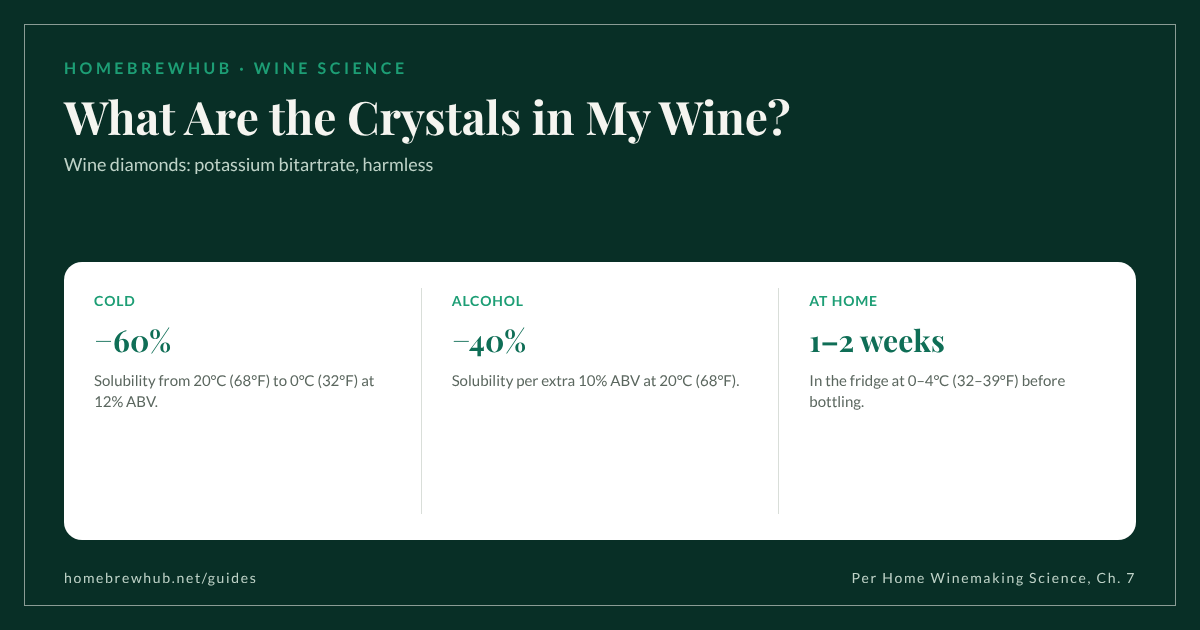
Tartrate solubility drops sharply with two things: low temperature and high alcohol. According to the experimental data summarized in Home Winemaking Science, at 12% alcohol by volume the solubility of potassium bitartrate falls by roughly 60% when the wine is cooled from 20°C (68°F) to 0°C (32°F). Alcohol works in the same direction: every additional 10% by volume lowers solubility by roughly 40% at 20°C (68°F). So a stronger wine, at the same temperature, is more prone to dropping crystals than a lighter one.
| Factor | Effect on crystals |
|---|---|
| Cooling from 20°C (68°F) to 0°C (32°F), at 12% ABV | Solubility down roughly 60% |
| Each additional 10% ABV, at 20°C (68°F) | Solubility down roughly 40% |
| pH rising from 3.0 to 4.0 | Share of tartaric acid in the crystal-forming form rises from 43% to 71% |
Why does pH matter?
Only part of the tartaric acid in wine exists as the bitartrate ion, the form that combines with potassium into an insoluble crystal. That share rises from 43% to 71% across the pH range 3.0 to 4.0, peaking around 73% at pH 3.8. Higher-pH wines are therefore not only more vulnerable to spoilage; they also carry more raw material for crystals.
Wine diamonds aren't a sign of spoilage or a defect in the usual sense. For a gift or a wine you plan to show off, though, visual stability matters, which is why commercial wineries cold stabilize routinely.
How do you prevent them at home?
Get the crystals to drop out before bottling. The simplest method is to hold the finished wine in a refrigerator at around 0–4°C (32–39°F) for 1–2 weeks before bottling, then rack it off the sediment. It won't match the precision of commercial cold stabilization, but it's usually enough for home purposes.
Commercial wineries test stability by holding wine near freezing, typically −2°C (28°F) to 5°C (41°F), for several days and checking for crystals. A more sensitive "seeded" test adds extra potassium bitartrate, usually 200–600 mg/L, to give the crystals something to form on, which works faster and more reliably than waiting for them to appear on their own.
Cold stabilization only deals with tartrate. A wine that passes it can still turn hazy from unstable protein in summer heat, which is a separate problem: see Why Did My White Wine Turn Hazy?
Plan your wine from must to bottle in the Wine calculator. For SO₂ before bottling, see How Much SO2 to Add to Your Wine.
Why clear wine doesn't always stay clear
Home Winemaking Science, Chapter 7, covers all three types of instability: tartrate, protein and colloidal.
Educational content. Rules on home fermentation vary by country; check the law where you live. Full disclaimer