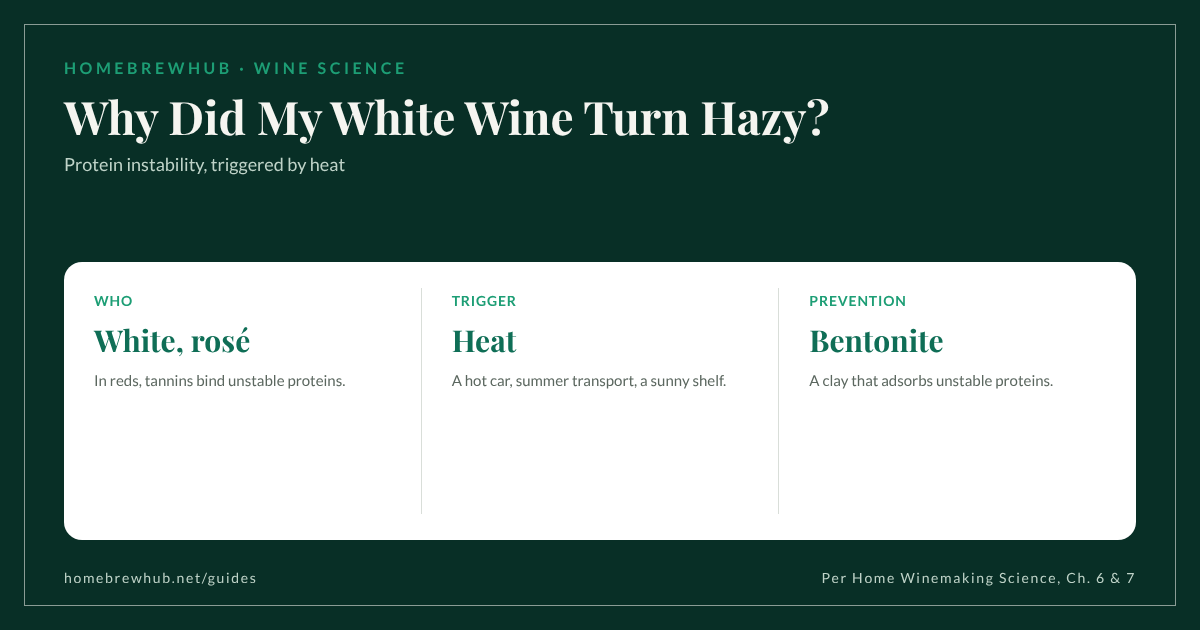
If a clear white or rosé turned hazy after being warm, the likely cause is protein instability. Some dissolved wine proteins stay in solution under normal storage, then denature and drop out when heated: a summer drive in a hot car, an uncooled container, a shelf in the sun. The usual prevention is bentonite, a clay that adsorbs those unstable proteins before the wine is bottled.
Why mostly white and rosé wines?
In red wines, unstable proteins are generally already bound and removed by tannins during fermentation and aging. White and rosé wines don't have enough tannin to do that, so the proteins stay in solution until heat makes them drop out.
Is it protein, or something else?
| What you see | Likely cause | Note |
|---|---|---|
| Haze after warm storage, white or rosé | Protein instability | Prevented with bentonite before bottling |
| Glassy crystals after chilling | Tartrate (wine diamonds) | Harmless; prevented by cold stabilization |
| Loose, hard-to-filter sediment over time | Colloidal instability | Polysaccharides, polyphenols and protein clumping together |
Summarized from Home Winemaking Science, Chapter 7.
How does bentonite work?
Bentonite is a swelling clay that works differently from protein-based fining agents such as gelatin or egg white. Rather than binding tannin, it adsorbs excess dissolved wine proteins and settles out with them. Each particle has a fixed number of binding sites, so as they fill up, every additional gram does less. That's why more isn't better: overdosing doesn't give a proportionally better result, but it does bring the risk of side effects.
Bentonite comes in sodium and calcium forms. The sodium form binds protein more efficiently at the same dose; the calcium form leaves a more compact sediment, which makes racking off the lees easier.
An overly harsh heat test can itself create sediment by oxidizing phenolics, which then looks like protein instability. Blindly following a harsh test often leads to adding bentonite where there was no real problem.
Why are heat tests tricky?
Standard heat tests range from one hour at 90°C (194°F) to two days at 50°C (122°F), followed by chilling. The trouble is that different versions agree poorly with one another, and wines respond differently to different temperatures and times. Wines also differ in natural protection: research has identified a haze-protecting factor in white wine, mostly polysaccharide (roughly 96% polysaccharide, 4% protein), that reduces the chance of haze under heat. That's one more reason a test on your specific wine beats a standard bentonite dose by eye.
Protein stability is independent of tartrate stability. A wine that passed cold stabilization can still turn hazy in summer heat, and the reverse. See What Are the Crystals in My Wine?
Plan your white wine from must to bottle in the Wine calculator.
Fining, filtration and stability
Home Winemaking Science covers fining agents including bentonite in Chapter 6 and all three types of instability in Chapter 7.
Educational content. Rules on home fermentation vary by country; check the law where you live. Full disclaimer