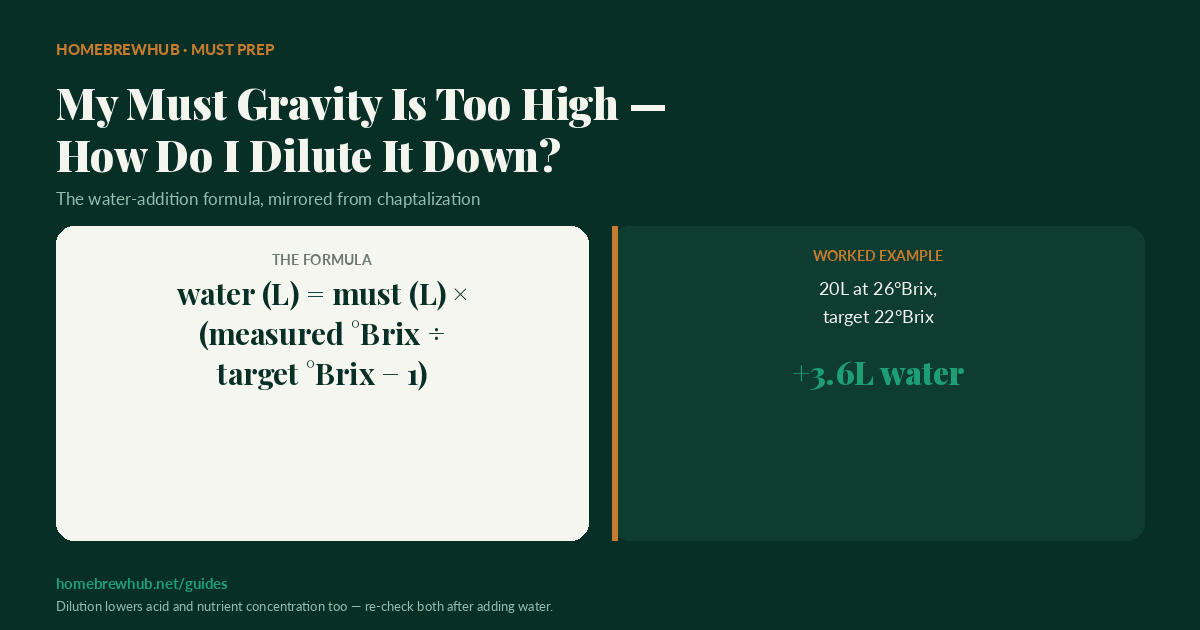
To calculate how much water to add: water (L) = must volume (L) × (measured °Brix ÷ target °Brix − 1). For example, 20L of must at 26°Brix diluted down to a 22°Brix target needs about 3.6L of water added.
Why must gravity ends up too high
This is the mirror image of the problem chaptalization solves. Where chaptalization raises a must that's under target, dilution brings one back down — usually because the fruit or juice came in riper or more concentrated than expected, or because a concentrate or juice blend was mixed stronger than the target style calls for.
An overly high starting gravity isn't just a stylistic mismatch. It can also push a batch past a yeast strain's alcohol tolerance, leaving fermentation stuck with unwanted residual sugar rather than finishing dry as intended.
Step 1: measure your actual must gravity
As with chaptalization, everything here starts from an accurate reading — take a hydrometer or refractometer measurement of your must before adjusting anything, correcting for temperature if your sample is far from the instrument's calibration range.
Step 2: know your target
Check your target style's OG range and pick a realistic point inside it. Diluting always pushes gravity down, so it's easy to overshoot past your target if you aim for the very bottom of the range.
Step 3: calculate the water addition
The formula: water (L) = must volume (L) × (measured °Brix ÷ target °Brix − 1)
To use it:
- Convert your measured gravity and target OG to °Brix (or use a combined SG/Brix reference chart)
- Divide measured °Brix by target °Brix, then subtract 1
- Multiply that result by your current must volume in liters to get liters of water to add
For example: 20L of must at 26°Brix, targeting 22°Brix, needs 20 × (26 ÷ 22 − 1) = about 3.6L of water.
Add water gradually rather than all at once — mix in a portion, stir thoroughly, then re-check gravity with the hydrometer before adding more. This is a starting-point estimate, not lab-exact chemistry, and real must composition varies enough that a second check is always worth the extra few minutes.
Dilution doesn't just affect sugar
Adding water lowers the concentration of everything else in the must too — acid, tannin, and yeast nutrients all get diluted right along with the sugar. A must that had adequate acidity or nutrient levels before dilution may need a small top-up afterward to stay in a healthy range for fermentation, so it's worth re-checking those numbers alongside gravity rather than assuming they're unaffected.
Skip the manual math
The wine calculator handles this conversion for your exact batch size and target style — enter your measured gravity and it works out the water addition automatically.
For the full must preparation process — including acid and nutrient adjustment after dilution — see Chapter 2 of Home Winemaking Science.
Hydrometer readings and sugar-to-Brix conversions are approximations — actual must chemistry varies by grape or fruit variety, ripeness, and acid balance. Always re-measure after adding water rather than relying on the calculation alone.