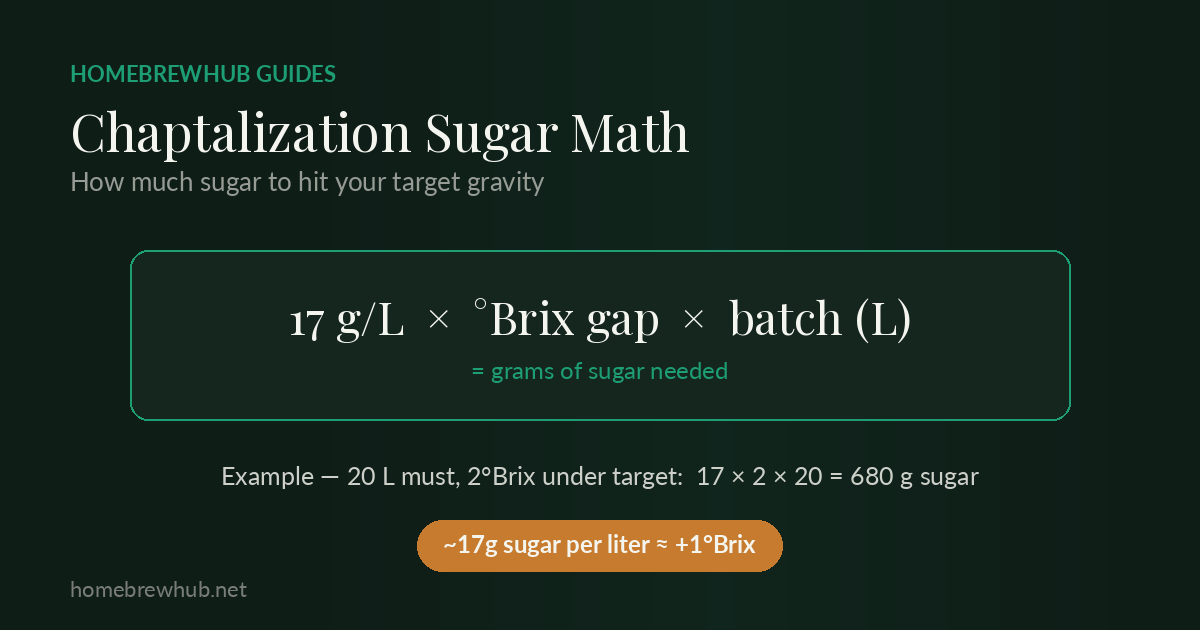
To calculate chaptalization by hand: about 17 grams of sugar per liter of must raises gravity by roughly 1°Brix. Multiply that 17g figure by the °Brix gap between your measured must and your target, then by your batch volume in liters, to get the total grams of sugar to add.
Why chaptalize at all
Wine's final alcohol comes from converting the sugar already present in the must. If your must's starting gravity (SG) sits below what your target style needs, the finished wine will land under your target ABV — sometimes noticeably so. Chaptalization simply tops up that sugar before fermentation starts, so the yeast has enough to work with.
This is routine practice in home winemaking, not a shortcut or a flaw — grape sugar content varies by vintage, ripeness, and climate, and most target style ranges assume you'll adjust for what you actually measured.
Step 1: measure your actual must SG
Before adding anything, take a hydrometer reading of your must. This is your starting point — every calculation from here depends on this number being accurate, not the number printed on a recipe or the "typical" reading for your grape variety.
Temperature affects hydrometer readings. Most hydrometers are calibrated for 15.5–20°C (60–68°F) must — if your sample is significantly warmer or colder, correct the reading before using it, or you'll be chaptalizing against a number that's already off.
Step 2: know your target
Your target starting gravity comes from the style you're making — a light, low-alcohol white sits at a different OG than a full-bodied red intended for extended aging. Check your style's target OG range and pick a realistic point inside it, not the top edge, since chaptalization always pushes gravity up and it's easy to overshoot.
Step 3: calculate the sugar
The standard home-winemaking approximation: about 17 grams of sugar per liter of must raises gravity by roughly 1°Brix.
To use it:
- Convert your measured SG and target OG to °Brix (or use a combined SG/Brix reference chart)
- Find the difference in °Brix between where you are and where you need to be
- Multiply that difference by ~17 g, then by your batch volume in liters
For example: a 20 L batch sitting 2°Brix under target needs roughly 2 × 17 × 20 = 680 g of sugar.
This is a starting-point estimate, not lab-exact chemistry — real must composition varies. Dissolve the sugar into a small portion of must first, stir it back in thoroughly, then re-check your gravity with the hydrometer before fermentation begins. Adjust from there if needed.
A common mistake: chaptalizing all at once for high-alcohol styles
For styles that need a large gravity jump — port-style fortified wines being the extreme case — adding all the sugar in one go can shock the yeast or stall fermentation before it reaches your target. Staged additions over several days, letting fermentation re-establish itself between each one, work far more reliably than one large dose.
Skip the manual math
The wine calculator does this conversion for your exact batch size and target style — enter your measured SG and it works out the sugar addition automatically.
For the full must preparation process — from crush to fermentation-ready — see Chapter 2 of Home Winemaking Science.
Hydrometer readings and sugar-to-Brix conversions are approximations — actual must chemistry varies by grape variety, ripeness, and acid balance. Always re-measure after adding sugar rather than relying on the calculation alone.