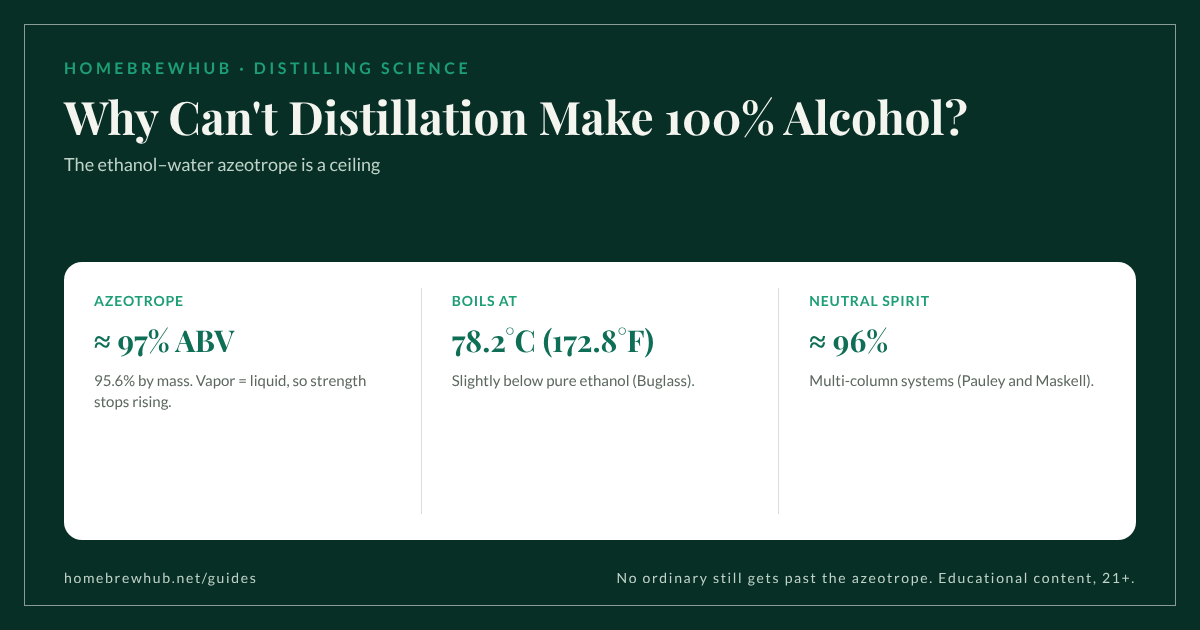
Because ethanol and water form an azeotrope. At about 97% alcohol by volume (95.6% by mass), the vapor rising from the liquid has exactly the same composition as the liquid itself, so distilling it again no longer raises the strength. That mixture boils at 78.2°C (172.8°F). It's a ceiling no ordinary still can get past; industrial neutral spirit comes off at about 96%.
Why does distillation raise the strength at all?
Because the vapor above a mixture is richer in its more volatile component. Buglass explains the principle with two similar liquids: if 40% of the molecules in a hexane and heptane mixture are hexane, the vapor above it is already about 69% hexane. Condense that vapor and heat it again, and the new vapor is richer still. Each round of evaporation and condensation is one stage of separation.
Alcohol and water follow the same logic up to a point. According to Buglass, one pass through a simple pot still takes an 8% wash to about 30%, and a second to about 65–70%.
What is the ethanol-water azeotrope?
An alcohol and water mixture isn't ideal: the molecules link through hydrogen bonds, and the mixture doesn't follow the simple rule. The main consequence, according to Buglass, is an azeotrope, a composition at which vapor and liquid are identical. As long as the liquid is weaker than the azeotrope, each stage raises the strength of the vapor. Once the liquid reaches the azeotropic composition, the vapor comes off exactly the same, and further distillation changes nothing.
A mixture of about 97% alcohol by volume (95.6% by mass) boils at 78.2°C (172.8°F), and its vapor has the same composition as the liquid. However many times you distill, the spirit won't get stronger than the azeotrope without special methods.
Is the azeotrope 95.6% or 97%?
Both, in different units. Buglass gives 95.6% alcohol and 4.4% water "by volume"; Smiley gives 97.3% by volume. In reference literature, 95.6% is the share of alcohol by mass, which corresponds to roughly 97% by volume. So both figures describe the same mixture. The boiling point agrees too: Buglass gives 78.2°C (172.8°F), Miller and Smiley 78.15°C (172.67°F).
How close do real stills get?
| Spirit and method | Strength off the still | Source |
|---|---|---|
| Armagnac, single distillation | about 53% | Buglass |
| Cognac, double distillation, heart | about 70% | Buglass |
| Triple-distilled Irish whiskey | over 85% | Buglass |
| Neutral spirit, multi-column systems | about 96% | Pauley and Maskell |
Most spirits stop far short of the ceiling on purpose. The fewer stages of separation, the more of the wash's aroma stays in the spirit: Armagnac at 53% keeps much of it, while neutral spirit for vodka and gin, close to the azeotrope, keeps almost none. Regulations often cap the strength too: under the 1989 EU regulation cited by Buglass, fruit spirits must be distilled to below 86%.
How pot stills and columns pack in stages of separation: Pot Still vs Column Still. Bringing a strong spirit down to drinking strength: the free Proofing / Dilution calculator.
The physics behind every still
Home Distilling Science, Chapter 5, covers vapor and liquid, the azeotrope, reflux, and why congeners don't leave the still strictly by boiling point.
Educational content about the science of distillation. Distilling spirits at home without a license is illegal in many countries, including the United States. Check the law where you live. This guide does not give still settings or cut points. Full disclaimer