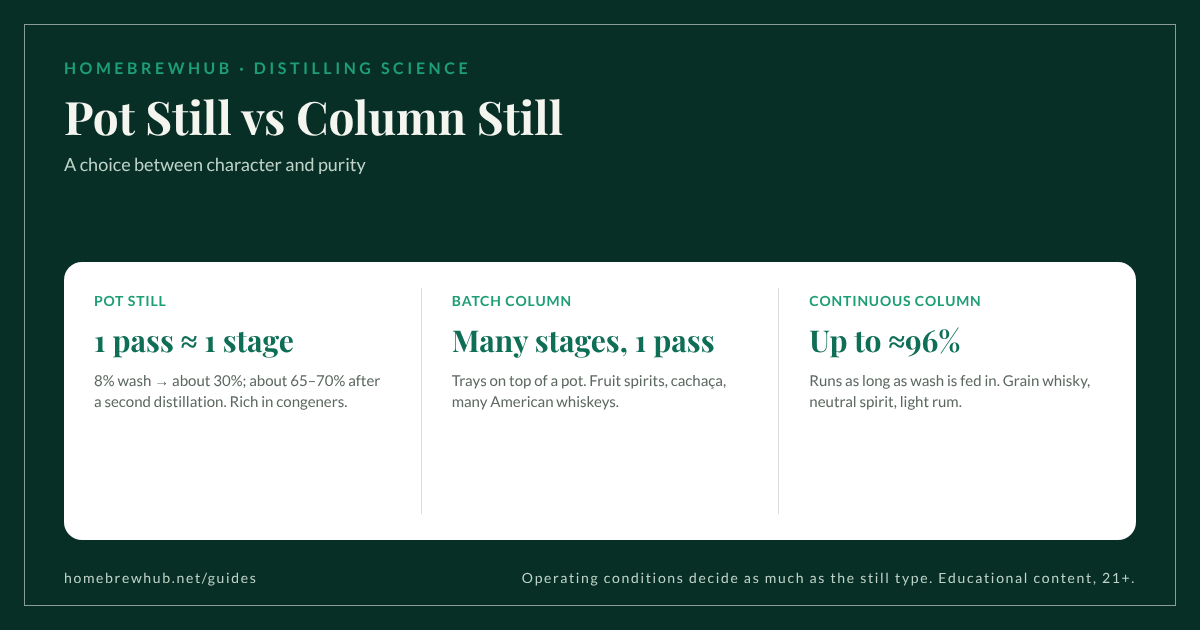
A pot still distills in batches, and one pass is roughly one stage of separation, so the spirit keeps much of the wash's character. A column still stacks many stages of separation into a single pass, using trays or packing and reflux, so the spirit comes off stronger and cleaner. In the words of Home Distilling Science, choosing between them is above all a choice between character and purity.
What does one pass through a pot still give?
Each round of evaporation and condensation is one stage of separation. According to Buglass, a wash at 8% gives about 30% in one pass through a simple pot still (the "low wines" of whisky), and wine at 12.5% gives about 40%. A second distillation brings the strength to about 65–70%, and a third to 80% and above: triple-distilled Irish whiskey comes off at over 85%. With so few stages, many of the wash's aroma compounds come through with the alcohol.
How does a column do many distillations at once?
A column fits many stages of separation into one pass. In a batch column still, a column of trays sits between the pot and the condenser, and each tray works as a separate distillation. Vapor rises, part of it condenses and runs back down (reflux), and every tray enriches the vapor a little more. The more stages and the more reflux, the closer the spirit gets to the ethanol and water azeotrope, a ceiling near 97% ABV that no ordinary distillation can pass.
A continuous column, the Coffey still patented by Aeneas Coffey in 1831, takes this further. Wash is fed in continuously and steam strips the alcohol from it, so the still runs as long as wash keeps coming. According to Pauley and Maskell, a system of several columns produces neutral spirit at about 96% with almost no congeners.
| Type of still | Spirit strength | Character | Examples |
|---|---|---|---|
| Pot still | About 70% after two distillations | Rich, high in congeners | Scotch malt whisky, Cognac, some rum |
| Batch column | Wide range in one pass | Adjustable | Fruit spirits, cachaça, many American whiskeys |
| Continuous column | About 96% for neutral spirit | Light to nearly neutral | Grain whisky, neutral spirit, light rum |
Sources: Buglass; Walker and Hill; Pauley and Maskell, as summarized in Home Distilling Science, Chapters 5 and 6.
Is a column still better than a pot still?
Not as a rule. Smiley considers a simple pot still too rudimentary for good whiskey and prefers a column. Buglass disagrees: each type has its own character, and each can produce superb spirits if operated properly. The pomace spirit studies he cites found that differences attributed to pot versus column came down mainly to operating conditions, not the type of apparatus. The entire Scotch malt whisky industry runs on pot stills.
Higher strength isn't always the goal either. Regulations often cap it so the spirit keeps the character of its raw material: under the 1989 EU regulation cited by Buglass, fruit spirits must be distilled to below 86%, and Scotch grain whisky to below 94.8%.
The type of still sets the possibilities, but the operating conditions decide the result. Comparative studies link differences between pot-still and column spirits primarily to how the distillation was run: speed, temperature and the amount of reflux.
Why is copper used in both?
Copper binds foul-smelling sulfur compounds from the grain and the fermentation. According to Buglass, distillate from stills made entirely of stainless steel can carry cooked-vegetable and cabbage notes, which is why copper turns up in almost every still, pot or column, even if only as internal parts.
Still design, explained
Home Distilling Science, Chapter 6, covers the anatomy of the pot still, double distillation, batch and continuous columns, copper, and stills for gin. Chapter 5 explains the physics behind every stage of separation.
The still comes after the wash. The Spirits catalog has wash profiles for 16 spirits, and the free Wash Recipe & ABV calculator checks your wash strength. Background: Home Distilling Science.
Educational content about the science of distillation. Distilling spirits at home without a license is illegal in many countries, including the United States. Check the law where you live. This guide does not give still settings or cut points. Full disclaimer