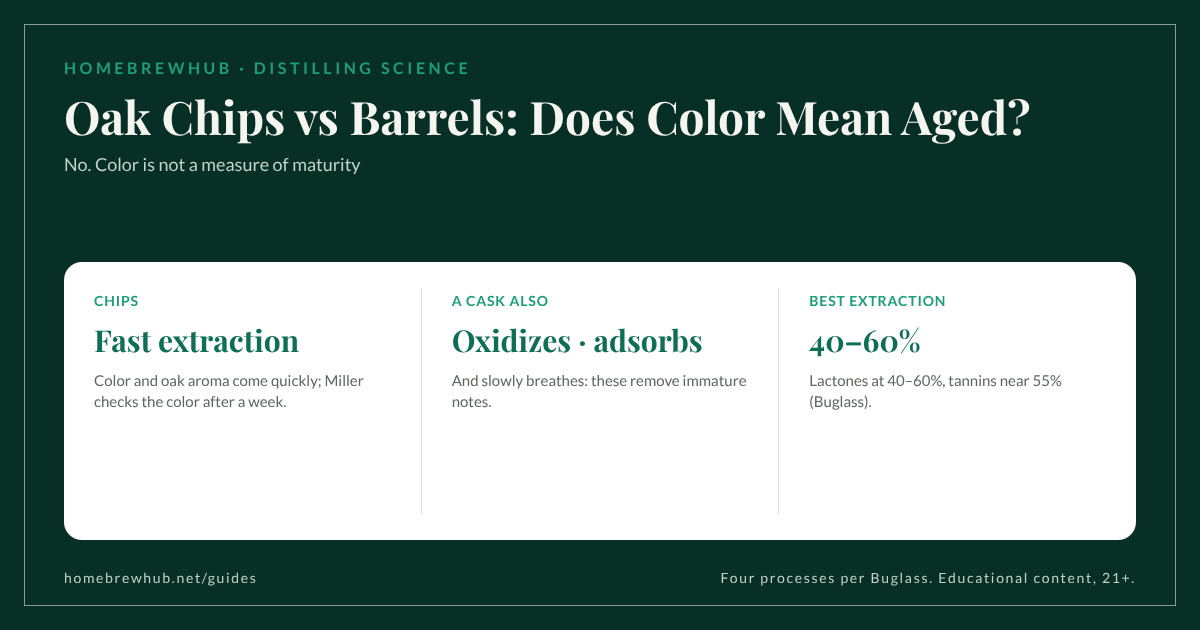
No. Color is not a measure of maturity. Oak chips give a spirit color and oak aroma quickly, but a cask does four things: oxidation, extraction from the wood, adsorption of unwanted compounds onto the wood, and slow loss through the walls. Chips mostly speed up extraction. The processes that remove immature notes take time, and many very dark rums and whiskies are colored with caramel anyway, as Miller points out.
What actually happens to a spirit in a cask?
| Process | What it does |
|---|---|
| Oxidation | Oxygen seeps in through the wood; fusel alcohols, ethanol and aldehydes oxidize, some to acids that slowly form fruity esters |
| Extraction | Compounds pass from the oak into the spirit: vanillin, lactones, tannins, color |
| Adsorption | Some compounds, sulfur compounds above all, soak into the wood and stay there |
| Loss through the walls | Alcohol and water escape: the angels' share |
After Buglass, as summarized in Home Distilling Science, Chapter 8.
According to Buglass, oxidation and extraction build mature flavor and mask immature notes, while oxidation and adsorption remove immature and unwanted ones. Chips in a jar give fast extraction; they don't reproduce the slow exchange through a stave.
Chips quickly give color and oak aroma, but maturation isn't only extraction. Oxidation, adsorption and slow reactions between compounds from the spirit and the wood also take place in the cask, and they are what remove immature notes. Color is not a measure of maturity.
What does the wood add to the flavor?
| Compound | Contribution |
|---|---|
| Vanillin, syringaldehyde | Vanilla, caramel |
| Whisky lactone | Coconut, sweet and woody notes |
| Eugenol | Clove |
| Furfural | Toasted almond |
| Ellagitannins | Mouthfeel, astringency, color |
Toasting releases these: heat breaks lignin into vanillin and phenols, turns lipids into whisky lactones and caramelizes carbohydrates. Charring adds a black layer that acts as a filter and adsorbent. That's why a light toast and a heavy char give different results.
What strength extracts best from oak?
According to data Buglass cites for brandy, lactones are extracted best at 40–60%, tannins and lignin products in Armagnac at 55%, and above 60% extraction of color, solids, tannins and volatile acids declines. Miller recommends 55–62% for home whiskey and warns against diluting to drinking strength before aging.
How do home distillers use oak?
A 200-liter cask is no use at home. Miller ages spirit in half-gallon (about 2 L) glass jars with oak chips she toasts herself, always outdoors because of the smoke. A vanilla smell appears as soon as the chips heat; for a light toast she stops there, for a heavier char she waits until the edges turn black. The chips must cool completely before going into strong spirit, because a spark may be smoldering inside. She judges the amount by color, adding more if the spirit hasn't darkened enough after a week.
A popular claim says a month in a 1-gallon (about 4 L) cask equals a year in a full-size barrel. Miller herself describes it as something she "read somewhere," and the sources offer no data to confirm it. What does hold: the smaller the vessel, the faster maturation runs. Smiley advises storing spirits in glass, not plastic.
How much a cask loses each year and why some spirits get stronger in oak: The Angels' Share. Bringing aged spirit to bottling strength: the free Proofing / Dilution calculator.
What the cask actually does
Home Distilling Science, Chapter 8, covers the four processes in the cask, American vs European oak, toasting and charring, cask history, rancio and aging at home.
Educational content about the science of distillation. Distilling spirits at home without a license is illegal in many countries, including the United States. Check the law where you live. This guide does not give still settings or cut points. Full disclaimer