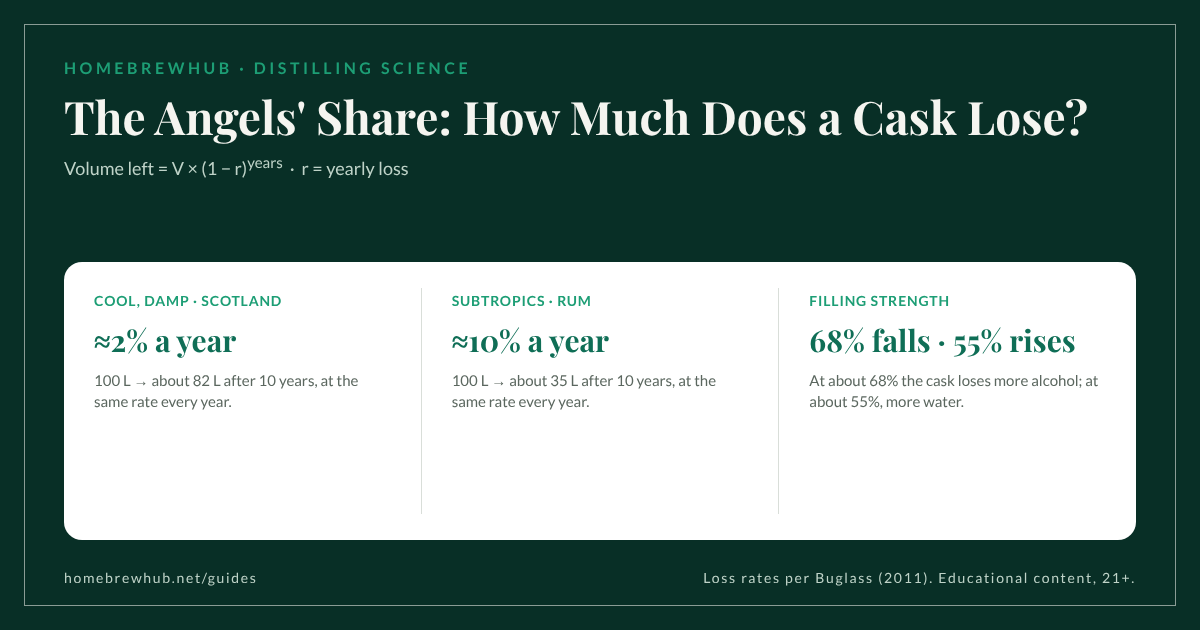
About 2% a year in a cool, damp climate, and about 10% a year in the subtropics. According to Buglass, whisky in Scotland loses about 2% of its volume a year, while rum in the subtropics loses about 10%. Whether the spirit left behind gets stronger or weaker depends on the strength it was filled at and on the humidity of the warehouse.
How much is left after 10 years in a cask?
If the same yearly loss holds every year, the volume left after a number of years is:
Volume left = V × (1 − r)years, where V is the starting volume and r is the yearly loss (0.02 for 2%, 0.10 for 10%).
| Years in cask | At about 2% a year | At about 10% a year |
|---|---|---|
| Start | 100 L | 100 L |
| 3 years | 94.1 L | 72.9 L |
| 5 years | 90.4 L | 59.0 L |
| 10 years | 81.7 L | 34.9 L |
Yearly rates per Buglass. The table assumes the same rate every year; real casks vary with warehouse position, weather and cask size.
This is also why maturation times differ so much by climate. In cool Scotland, according to Buglass, malt whisky usually needs at least 10 years; for rum in the subtropics, 5 years is usually enough. A hot climate speeds up maturation and the losses together.
Why does a cask lose spirit at all?
A cask isn't airtight. Oxygen slowly seeps in through the pores of the wood, and some of the spirit escapes into the air the other way. That slow exchange is part of what maturation is: oxidation and evaporation of volatile compounds remove immature notes. The spirit that escapes is the angels' share.
Does the spirit get stronger or weaker in the cask?
It depends on the filling strength. According to Buglass, at about 68% the wood passes alcohol more easily than water, so the whisky's strength falls over time. At about 55% the wood passes water more easily, and the strength rises instead. Scotch malt whisky is usually filled at about 68%; bourbon and some other spirits at about 55%.
Humidity matters too, and here Buglass is not entirely consistent. In the brandy section he writes that alcohol usually passes through wood more slowly than water, except under high humidity, which is why brandy warehouses are kept at about 70% humidity. The general conclusion: the balance of losses depends on both strength and humidity.
A cask breathes selectively. At around 68% it loses more alcohol than water and the spirit weakens; at around 55% it loses more water and the spirit gets stronger. Filling strength decides how strong the spirit will be years later.
What about aging at home in small casks or jars?
The smaller the cask, the faster maturation goes, because there is more wood per liter of spirit. Beyond that general rule, the sources give no verified numbers for small vessels. A popular claim says a month in a 1-gallon (about 4 L) cask equals a year in a full-size barrel; Miller herself describes it as something she "read somewhere," and our sources offer no data to confirm it.
What the cask actually does
Home Distilling Science, Chapter 8, covers the four processes in the cask, American vs European oak, toasting and charring, rancio, and aging at home.
Bringing cask-strength spirit down to bottling strength? The free Proofing / Dilution calculator gives the water to add. The science behind it is in Home Distilling Science, Chapter 9.
Educational content about the science of distillation. Distilling spirits at home without a license is illegal in many countries, including the United States. Check the law where you live. This guide does not give still settings or cut points. Full disclaimer