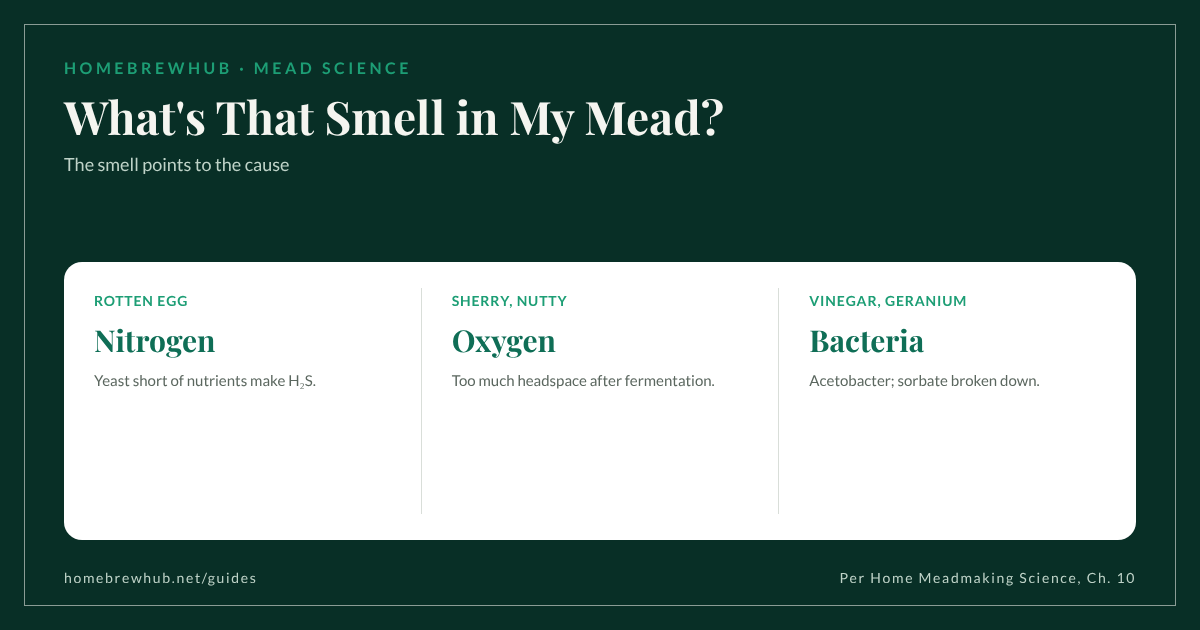
Most mead faults come from a small handful of causes: too little nitrogen for the yeast, too much oxygen after fermentation, bacteria, and the wrong temperature. Each leaves a recognizable smell. Rotten eggs or cabbage point to nitrogen. Sherry, nuts or green apple point to oxygen. Vinegar and geranium point to bacteria. Identify the smell, and the cause and the fix follow.
Quick reference: smell, cause, prevention
| Smell or taste | Likely cause | Prevention |
|---|---|---|
| Rotten egg, sharp gas | Hydrogen sulfide from yeast short of nitrogen | Staggered nutrient additions, good aeration at the start |
| Cooked cabbage, onion, rubber | Mercaptans and disulfides that develop from hydrogen sulfide | Same as for hydrogen sulfide |
| Sherry, nutty, darkening color | Oxidation | Minimal headspace, airlock kept topped up |
| Green apple, hay | Acetaldehyde, a product of oxidized ethanol | As for oxidation; modest sulfite |
| Vinegar, sharp | Acetobacter bacteria | Sanitation, avoiding late oxygen contact, sound fruit |
| Crushed geranium leaves | Lactic acid bacteria breaking down sorbate | Sorbate only after sulfite, never with MLF |
| Butter, popcorn | Diacetyl from malolactic bacteria or wild yeast | Sanitation |
Summarized from Home Meadmaking Science, Chapter 10.
Why does my mead smell like rotten eggs?
Hydrogen sulfide forms when yeast don't get enough nitrogen during fermentation. That's why staggered nutrient additions do more than speed things up: they prevent this exact fault. Too little aeration at the start and long contact with the yeast sediment after fermentation add to the risk. Left alone, hydrogen sulfide can turn into mercaptans and dimethyl sulfide, which smell of cooked cabbage, spoiled garlic or sharp gas. Yeast strains differ noticeably in how much sulfur they produce, so if the problem keeps coming back, change the strain for the next batch.
Why does my mead taste like sherry?
Oxidation is the most common fault after fermentation. The signs are a darker color, a muted aroma, more bitterness, haze in a mead that was clear, weaker fruit notes and, further along, a sherry-like, nutty character. Acetaldehyde is a specific case: it forms from the oxidation of ethanol and comes across as green apple or dried hay. The usual causes are too much headspace in the vessel, an airlock that has dried out, and film-forming yeast during long barrel aging. Tannic meads resist it better than light, delicate ones.
About 25 ppm of free sulfur dioxide holds back both Acetobacter and acetaldehyde buildup. One preventive step covers two faults.
Vinegar and geranium: two bacterial faults
A sharp, vinegary smell points to Acetobacter. It needs oxygen to grow, so poor sanitation combined with late oxygen contact is the classic trigger, along with high fermentation temperatures and overripe or damaged fruit in melomels.
A crushed geranium leaf smell is a different bacterial fault: lactic acid bacteria breaking down sorbic acid from potassium sorbate. It's controlled by the order of additions, which has its own guide: Sulfite Before Sorbate. Some sorbate faults also take time to appear. Its conversion into ethyl sorbate, with a bubblegum or artificial-fruit note, typically takes 6 to 12 months, so a clean mead at bottling isn't a guarantee.
What if the mead just stopped fermenting?
A stuck fermentation isn't a flavor fault, but it often gets mistaken for a finished one. If the final gravity sits noticeably higher than the strain's stated alcohol tolerance would predict, it has probably stuck rather than finished.
First, raise the temperature gently into the 21–24°C (70–75°F) range. That is often enough on its own. If it isn't, restart with fresh yeast: mix a small portion of the stuck mead with a new batch of active yeast, and once it's fermenting, fold in the rest of the mead in stages rather than all at once, which risks a second stall.
Most sulfur problems start with nitrogen. See How Much Yeast Nutrient (DAP) Should You Add to Mead? or plan the batch in the Mead calculator.
Faults, and the causes behind them
Home Meadmaking Science covers nutrition in Chapter 3, fermentation temperature in Chapter 5, headspace and stabilization in Chapter 7, and fault diagnosis in Chapter 10.
Educational content. Rules on home fermentation vary by country; check the law where you live. Full disclaimer