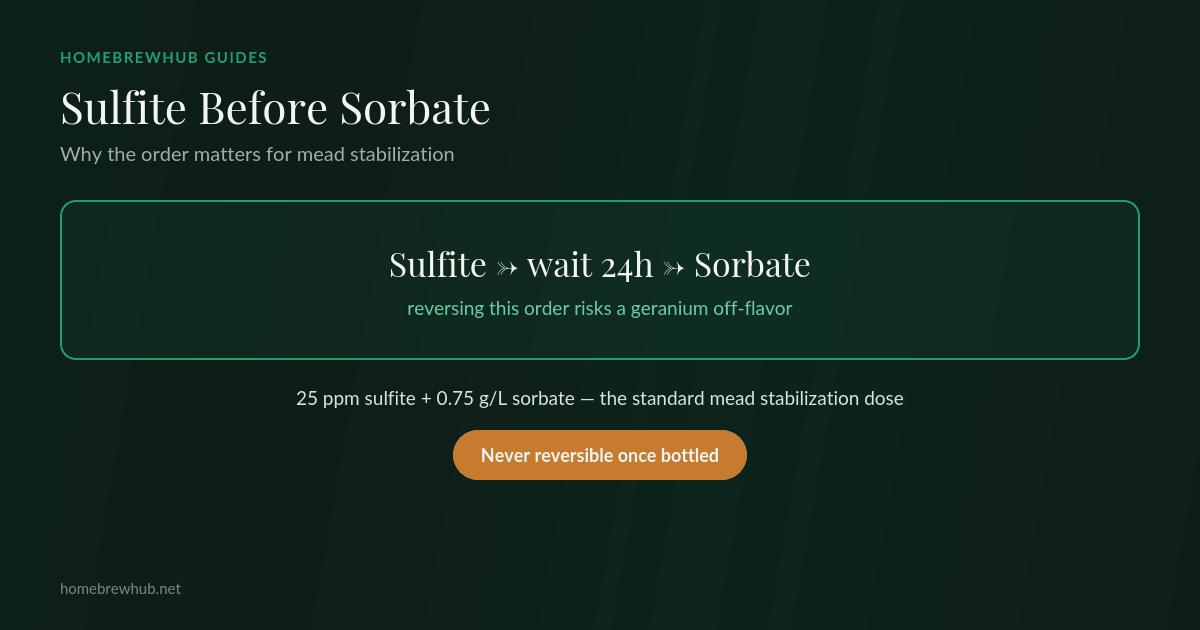
Always add potassium metabisulfite (sulfite) to mead first, wait at least 24 hours, then add potassium sorbate. Reversing this order lets lactic acid bacteria convert sorbic acid into a compound with a distinctive, unmistakable smell of crushed geranium leaves — and there's no way to fix it once the mead is bottled.
What stabilization is actually for
Stabilization isn't about improving flavor — it locks in what fermentation and aging have already achieved, and protects the mead from spoiling in storage. Two additives do two different jobs:
- Potassium metabisulfite (sulfite) holds back the growth of Acetobacter and other unwanted bacteria, and helps prevent oxidation.
- Potassium sorbate prevents any remaining live yeast from fermenting residual sugar again after bottling.
What's the correct order, and how much of each?
- Add potassium metabisulfite first, targeting around 25 ppm free SO2.
- Wait at least 24 hours before adding anything else.
- Add potassium sorbate, at approximately 0.75 g per liter (check your specific product's label, as concentration varies by brand).
Lactic acid bacteria that end up in the must can metabolize sorbic acid (from potassium sorbate) into a compound called 2-ethoxyhexa-3,5-diene — the source of the crushed-geranium smell. Sulfite added first suppresses those bacteria before sorbate is ever introduced, removing the organism that causes the reaction in the first place.
When you don't need sorbate at all
If your mead has fully fermented to a stable final gravity and you're not planning to back-sweeten it, sorbate isn't necessary — its only job is preventing residual sugar from refermenting. A hydrometer reading that holds steady for several consecutive days is a reliable sign fermentation has genuinely finished.
Sorbate should also never be used on a mead that has undergone, or will undergo, malolactic fermentation — the same lactic acid bacteria involved in that process are exactly the ones that cause the geranium reaction.
The geranium off-flavor doesn't always show up immediately. Sorbic acid's conversion into the geranium-smelling compound can take anywhere from a few weeks to several months, depending on temperature, pH, and alcohol level — so a batch that seems fine right after bottling isn't necessarily in the clear.
Get the exact dose for your batch
The mead calculator's Stabilization tool works out precise sulfite and sorbate amounts for your batch size — in the right order, automatically.
For the full chemistry of stabilization, aging, and fault diagnosis, see Home Meadmaking Science, Chapters 7 and 10.
Handle potassium metabisulfite and potassium sorbate as directed on the product label. Sulfite can trigger reactions in people with sulfite sensitivity — label any mead you share accordingly.