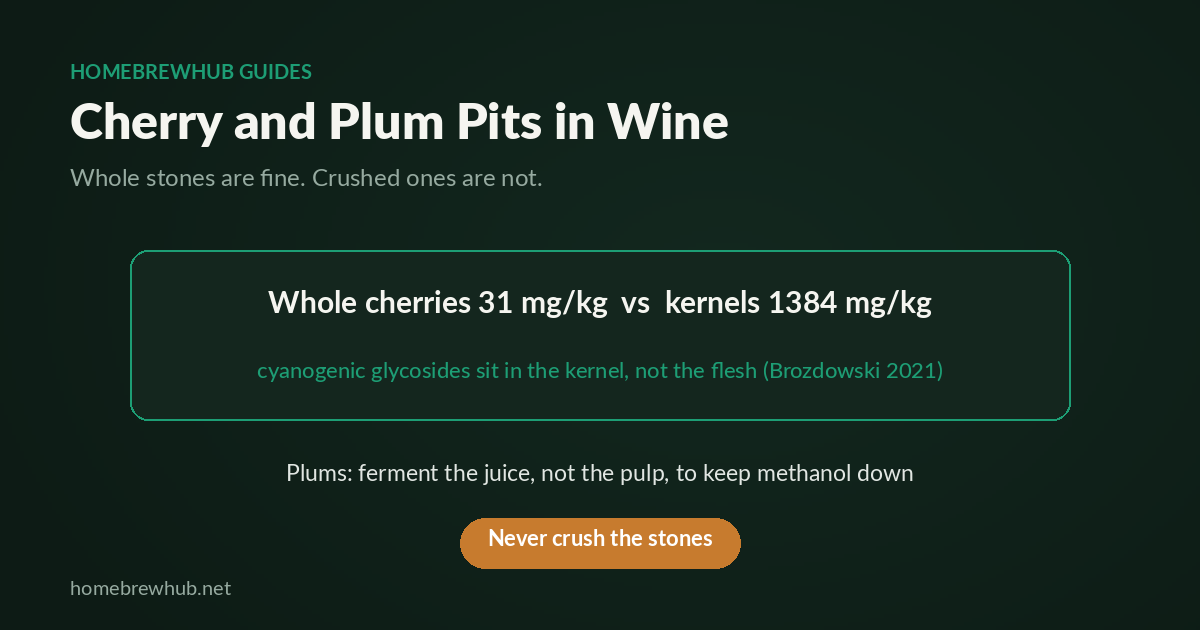
You do not have to remove cherry or plum pits, but you must never crush them. Stone fruits contain cyanogenic glycosides, mainly amygdalin and prunasin, which release hydrogen cyanide when the tissue that holds them is damaged, and they sit in the kernel, not in the flesh. Whole black cherries with uncrushed stones held about 31 mg/kg of glycosides, while sweet cherry kernels hold about 1384 mg/kg. So stones go into the must whole or not at all. For plums there is a second reason for care: fermenting on the pulp raises methanol, so plum wine is made from the juice.
Why are crushed pits a problem?
| Material | Cyanogenic glycosides or cyanide |
|---|---|
| Black cherry fruit, whole, stone not crushed | 31 mg/kg glycosides |
| Sweet cherry kernels | 1384 mg/kg glycosides |
| Peach kernel | 470 mg HCN/kg |
| Cherry juice | 0.5-12 mg HCN/kg |
| Plum juice | 0.33-1 mg HCN/kg |
From Home Fruit & Country Winemaking Science, Chapter 11, after Brozdowski and co-authors (2021) and EFSA (2019).
Between the juice and the kernel there are two to three orders of magnitude. Crushing, grinding or milling the stones is what moves the glycosides from the kernel into the must.
How much cyanide is too much?
The European Food Safety Authority set an acute reference dose for cyanide of 20 µg per kg of body weight (2016, confirmed in 2019), which is 1.4 mg in one sitting for a 70 kg adult. EU rules (Regulation (EC) No 1334/2008) allow up to 35 mg/kg of hydrocyanic acid in alcoholic beverages. Juice figures vary widely between sources, and that spread is a reason to follow the rule rather than to calculate your way around it.
Should you pit cherries before making wine?
Either is fine as long as no stone is cracked. In the HomeBrewHub cherry recipes the cherries are crushed in a straining bag without breaking the stones, and pulp and stones are discarded together at the end of maceration. If you pit by machine, check for split stones and throw those out.
The difference between a safe stone-fruit wine and a questionable one is almost entirely mechanical: whole stones are fine, crushed ones are not.
Why is plum wine made from juice and not pulp?
Methanol comes from pectin, not from sugar, and plums are rich in pectin, 2.0-3.5% by mass. Plum wine regularly holds more than 250 mg/L of methanol, above the OIV limit for white and rosé grape wines, and one trial measured 1265 mg/L after the pulp was fermented for 7 days at 25 °C (77 °F) (Miljić and Puškaš, 2014, via the Kosseva handbook). That is why the HomeBrewHub plum recipe soaks the fruit with pectic enzyme for a few days, presses it and ferments only the juice.
See how it is done in the free Dry Sour Cherry Wine and Plum Wine recipes.
Stones, methanol and safety, in depth
Home Fruit & Country Winemaking Science covers cyanide from stones in Chapter 11 and methanol in Chapter 6.
Educational content. Make and drink alcoholic beverages only if you are of legal drinking age where you live, and check local rules before making alcoholic drinks. Full disclaimer