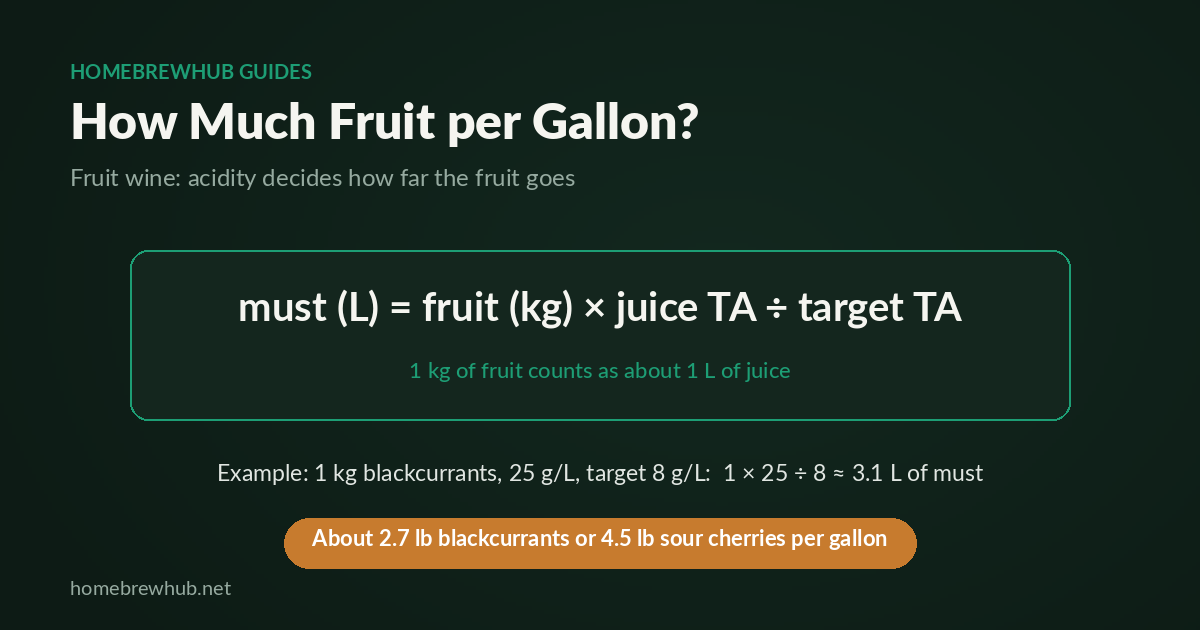
There is no single amount of fruit per gallon: it depends on how acidic the fruit is. Most fruit juice is too sharp to ferment as it is, so it is diluted with water until the must reaches a target acidity, and sugar makes up for the water. A sharp fruit like blackcurrant goes about three times further than its own volume: 1 kg of berries makes about 3.1 L of must. A mild fruit like strawberry cannot be diluted much at all, so you add acid instead. In the HomeBrewHub catalog that works out to about 2.7 lb of blackcurrants per US gallon but about 4.5 lb of sour cherries.
How do you work out the amount of fruit?
Water dilutes acid in proportion to volume. If a liter of juice holds 24 g of acid and the must needs 8 g/L, the volume has to triple: 1 L of juice plus 2 L of water. In general:
must volume = juice volume × juice acidity ÷ target acidity
For whole fruit, 1 kg of fruit can be treated as about 1 L of juice for this calculation (Kosseva handbook, 2017).
Worked example: 1 kg of blackcurrants at 25 g/L of acid, with a target of 8 g/L, gives 1 × 25 ÷ 8 = about 3.1 L of must. That is roughly 2 L of water and sugar for every kilogram of berries.
How much fruit per gallon for common fruit wines?
| Fruit | Juice acidity, g/L | Target, g/L | Fruit per US gallon (3.8 L) |
|---|---|---|---|
| Blackcurrant | 25-35 | 8 | about 1.2 kg (2.7 lb) |
| Red currant | 16-29 | 8 | about 1.4 kg (3 lb) |
| Gooseberry | 20-31 | 8* | about 1.4 kg (3 lb) |
| Raspberry | 12-21 | 8* | about 2.3 kg (5 lb) |
| Sour cherry | 12-19 | 6.5 | about 2 kg (4.5 lb) |
| Plum | 4-16 | 5.5-6 | about 2.3 kg (5 lb), never less than half the must |
| Strawberry | 6-10 | 8 | about 1.5 kg (3.3 lb), plus added acid |
Acidity ranges from Home Fruit & Country Winemaking Science, Chapter 1. Targets from the Kosseva handbook, Table 14.2; * gooseberry and raspberry are not in that table, so the berry-wine value of 8 g/L is used. Amounts: HomeBrewHub catalog recipes (5 L batches) converted to one US gallon, calculated at the low end of each acidity range.
Why do the published acidity figures matter so much?
Two published estimates for blackcurrant differ almost twofold. With the Kosseva handbook's 25-35 g/L, 1 kg of berries makes 3.1-4.4 L of must; with the 14-19 g/L measured by Nour and co-authors (2011), the same kilogram makes only 1.75-2.4 L. Dilute berries like the second set by the first figure and the wine comes out thin and soft; do the opposite and it is sharply acidic. If you can titrate your juice, use your own number: the fruit in your garden is not an average from a table.
Can you dilute too much?
Yes. Water lowers everything, not just acid: color, aroma and body go down with it. In a plum trial cited by the Kosseva handbook, pulp diluted 1:1 made an acceptable wine, while pulp diluted 1:2 made a thin, unbalanced and astringent one. Very sour fruit tolerates much more: sea buckthorn did best at 1:5. The more acidic the fruit, the further it can be stretched without losing flavor.
What if the fruit is not acidic enough to dilute?
Then acidity cannot set the amount. Strawberries (6-10 g/L) and sweet cherries (3-5 g/L) are close to or below the target already, so the amount of fruit becomes a matter of flavor and the missing acid is added by weight. Adding water still means adding sugar: about 18.7 g of sugar per liter raises the potential alcohol by 1%.
Enter your fruit weight and, if you measured it, your juice acidity in the free Must Builder: it gives the must volume, the water, the sugar and the acid. Or start from the free Blackcurrant Wine recipe.
Balancing the must, in depth
Home Fruit & Country Winemaking Science works through dilution, sugar and acid in Chapter 3; the Guide walks through a first batch of blackcurrant wine in Chapter 3.
Educational content. Make and drink alcoholic beverages only if you are of legal drinking age where you live, and check local rules before making alcoholic drinks. Full disclaimer