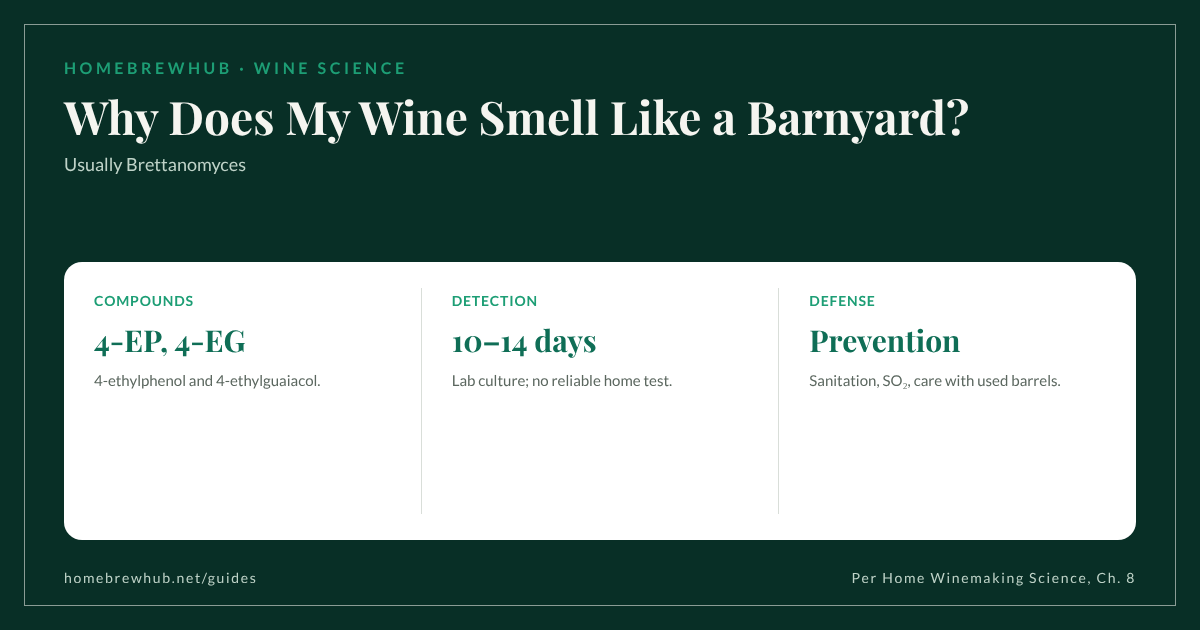
A barnyard, horsey, sweaty or stable smell usually points to Brettanomyces. This yeast, along with the closely related Dekkera, turns acids from the grape into volatile phenols, chiefly 4-ethylphenol and 4-ethylguaiacol. There's no reliable way to detect it early at home, so the realistic defense is prevention: sanitation, adequate SO₂ and caution with used barrels.
Where does the smell come from?
Brettanomyces converts two hydroxycinnamic acids naturally present in grapes, p-coumaric and ferulic acid, in two enzymatic steps. The products, 4-ethylphenol and 4-ethylguaiacol, are described as phenolic, sweaty, horsey, stable or, more neutrally, barnyard.
Is it always a fault?
Not necessarily, and that's what makes Brettanomyces unusual. Unlike acetic acid bacteria, whose result everyone recognizes as a defect, Brett depends heavily on concentration and on who's drinking. Some tasters find a small amount appealing, an earthy complexity in certain traditional Old World styles. Higher concentrations are a flaw by anyone's standard. There's no clean, objective threshold between the two.
Lab detection needs a special growth medium (Brettanomyces resists cycloheximide, unlike most yeasts) and 10 to 14 days for colonies to grow. At home, prevention is the only realistic defense.
How do you prevent it?
| Defense | Why it matters |
|---|---|
| Thorough sanitation, especially hoses and crevices | Wine residue left in equipment is where it survives |
| Consistently adequate SO₂ throughout storage | Holds spoilage organisms back for as long as the wine is stored |
| Caution with used oak barrels | One of the most common sources; wood can't be reliably sterilized |
Summarized from Home Winemaking Science, Chapter 8.
Can you fix a wine that already has it?
Only partly. Home Winemaking Science lists serious Brettanomyces spoilage among the problems that can't be fully fixed after the fact: filtration and SO₂ reduce it, but don't fully remove it once the concentration is already high. That's the strongest argument for getting the prevention right from the start.
SO₂ is your main tool here: How Much SO2 to Add to Your Wine. Plan the batch in the Wine calculator.
Spoilage, and how to keep it out
Home Winemaking Science, Chapter 8, covers acetic acid bacteria, Brettanomyces and refermentation in the bottle, under one defense logic.
Educational content. Rules on home fermentation vary by country; check the law where you live. Full disclaimer