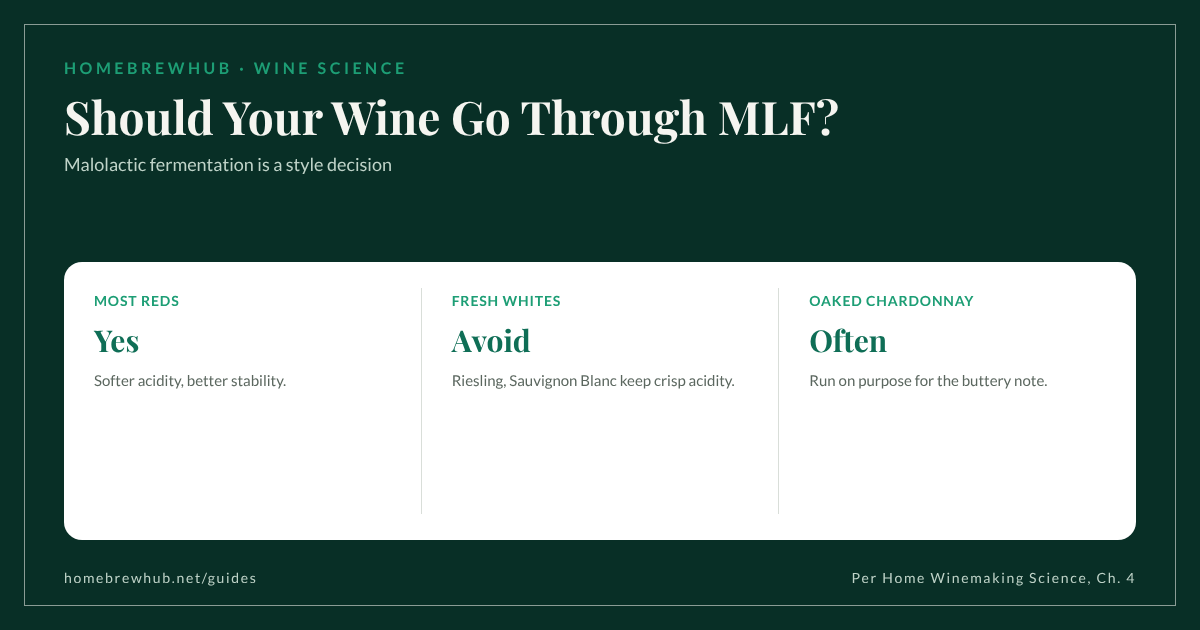
It depends on the style you're making. Most red wines benefit from full malolactic fermentation (MLF). Fresh, aromatic whites such as Riesling and Sauvignon Blanc generally avoid it or suppress it on purpose. Full-bodied, oak-aged whites such as classic Chardonnay are the exception and often run it deliberately for the buttery note.
What does MLF actually do?
Lactic acid bacteria, chiefly Oenococcus oeni, convert malic acid into lactic acid and carbon dioxide. That changes the wine on three independent fronts at once.
| Effect | What happens | The catch |
|---|---|---|
| Softer acidity | Titratable acidity drops, so the wine tastes less sharp | pH rises: up to about 0.2 units from a starting pH near 3.4, usually no more than 0.1 at lower pH |
| Stability | Malic acid is gone, so bacteria can't ferment it later in the bottle | Higher pH means weaker natural protection against spoilage |
| Aroma | Diacetyl adds a buttery, nutty note | Above roughly 5 mg/L (the historically cited figure) it reads as a defect, "spoiled butter" |
Summarized from Home Winemaking Science, Chapter 4.
In red wine, MLF usually also reduces color intensity a little, because the pH rise shifts the balance between forms of the red pigment. With an unusually large pH rise the hue can turn bluish. It's an expected side effect, not spoilage.
Which wines want MLF and which don't?
| Style | MLF? | Why |
|---|---|---|
| Most red wines | Yes, full | Softer acidity, better stability, added complexity |
| Fresh aromatic whites (Riesling, Sauvignon Blanc) | Avoid or suppress | Crisp acidity and clean fruit are the point |
| Full-bodied oak-aged whites (classic Chardonnay) | Often, on purpose | For the buttery, complex profile |
If you don't want MLF, avoiding it isn't enough: suppress it with adequate SO₂, filtration and cold stabilization. Wild lactic acid bacteria can start an uncontrolled MLF in the bottle months later.
Inoculate or wait?
For red wine where MLF is wanted, Home Winemaking Science recommends buying a commercial Oenococcus oeni culture and adding it shortly after, or at the same time as, the yeast. Spontaneous MLF from whatever bacteria happen to be present is impossible to predict in timing or outcome. Adding the bacteria together with the yeast also helps them avoid some of the inhibiting effect of alcohol, which is highest once the yeast have finished.
Cider makers face the same choice with a different tradition behind it: see Why Does Cider Start Fizzing Again in Spring?
Maceration also shapes a red's color and structure: How Long Should You Macerate Red Wine? Plan the batch in the Wine calculator.
Acidity, bacteria and style
Home Winemaking Science gives malolactic fermentation its own chapter (Chapter 4), from deacidification to diacetyl and color.
Educational content. Rules on home fermentation vary by country; check the law where you live. Full disclaimer