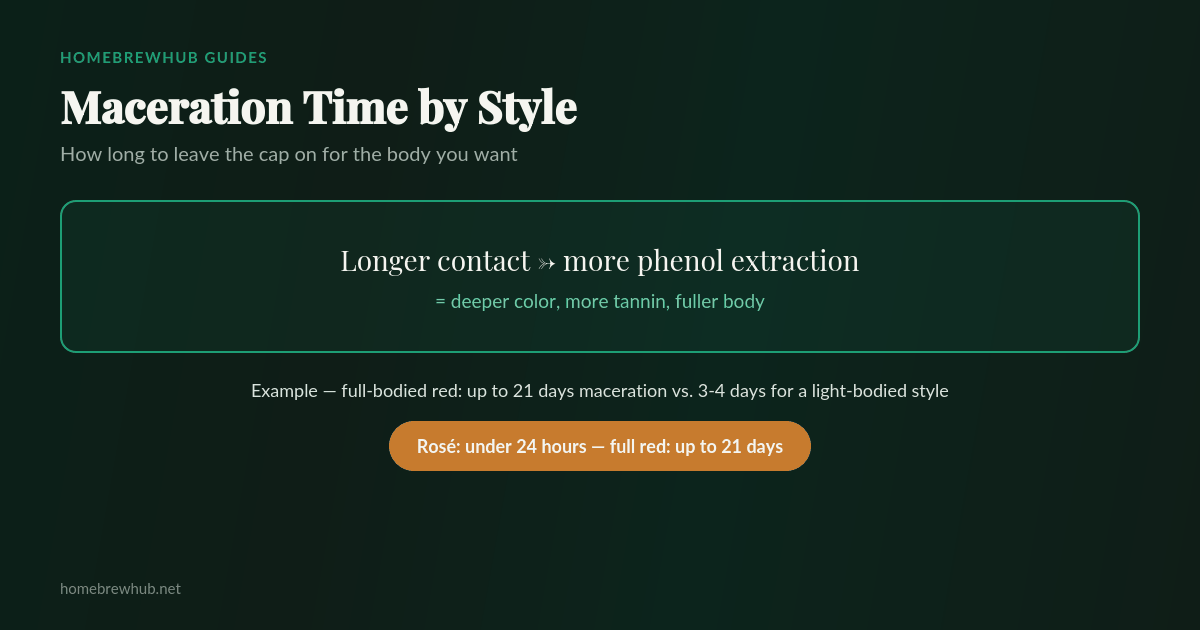
Maceration time for red wine depends on your target style: under 24 hours for rosé, 3-4 days for a light-bodied red, 5-7 days for medium-bodied, and up to 21 days for a full-bodied, deeply colored red. Longer contact between the fermenting must and the grape skins extracts progressively more color and tannin.
What maceration actually does
During red wine fermentation, the must ferments together with the grape skins (and often seeds) — the "cap" that forms and needs regular punching down or pumping over. The longer that contact continues, the more phenolic compounds — mainly color pigments (anthocyanins) and tannins — get extracted from the skins into the wine.
Maceration time by target style
| Target Style | Maceration Period | Phenol Extraction |
|---|---|---|
| Rosé | Up to 24 hours | Very low |
| Light-bodied, light-colored | 3-4 days | Low |
| Medium-bodied, medium-colored | 5-7 days | Medium |
| Full-bodied, deep-colored | Up to 21 days | High |
Rosé is typically made one of two ways: a short pre-fermentation skin contact (up to 24 hours) on red grapes before pressing off the lightly colored juice, or by directly pressing red grapes without extended contact at all. Either way, once the juice is separated from the skins, it ferments using the standard white wine process — not the extended-maceration red process.
Fermentation temperature during maceration
Red wine maceration typically happens at a warmer fermentation temperature than white wine — roughly 22-28°C (72-82°F) — though some winemakers ferment as cool as the chosen yeast strain allows, for a slower fermentation associated with premium quality results.
The cap of skins and seeds needs to be kept in contact with the fermenting liquid throughout maceration — either by punching it down or pumping juice over it regularly. Left undisturbed, the cap can dry out, harbor spoilage organisms, and stop contributing extraction evenly.
Optional malolactic fermentation
Many red wines undergo malolactic fermentation either during or after primary fermentation, softening the wine's acidity as part of the same overall process before pressing, racking, clarifying, and stabilizing.
Track your maceration schedule
The wine calculator's Recipe Builder includes the full vinification process for each style, including maceration timing and cap management.
For the full picture on tannin extraction, color stability, and maceration technique, see Home Winemaking Science, Chapter 05.
Maceration times here are general reference ranges — actual extraction also depends on grape variety, ripeness, temperature, and how often the cap is managed. Taste and monitor color/tannin directly rather than relying on time alone.