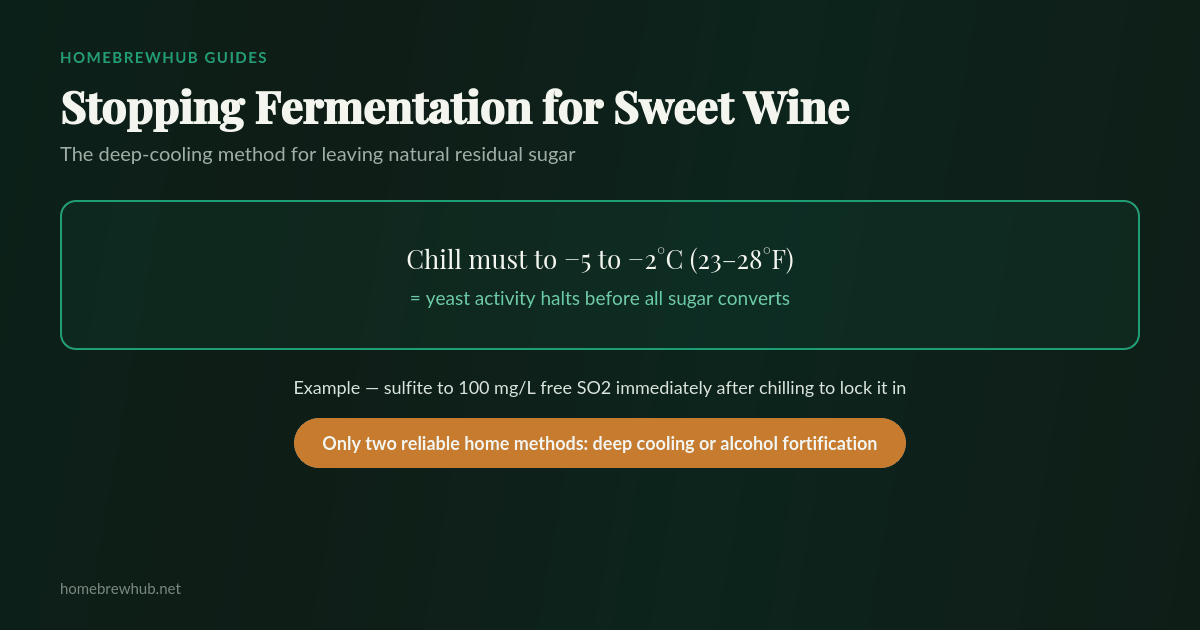
To stop wine fermentation early for natural sweetness: use half the normal yeast inoculum with no added nutrients, ferment at the low end of the style's temperature range, then chill the must to −5°C to −2°C (23–28°F) once the target sugar level is nearly reached, and sulfite immediately to 100 mg/L free SO2 to help lock the yeast down.
Why this takes planning from the start
Making a sweet wine by stopping fermentation isn't something you decide at the last minute — it starts at yeast pitching. Using only half the normal inoculum, skipping added nutrients, and fermenting at the cooler end of the style's range all keep the yeast population weaker and slower from the outset, making it realistically stoppable later rather than fighting a large, vigorous, well-fed colony.
The deep-cooling method, step by step
- Ferment with a reduced yeast inoculum, no added nutrients, at the cooler end of your target style's fermentation range
- Monitor sugar level closely as fermentation approaches your target — chill slightly before reaching the true target, since stopping isn't instant
- Chill the must to −5°C to −2°C (23–28°F) — up to 4°C (40°F) still works, just less decisively
- Sulfite immediately to 100 mg/L free SO2 once chilled
- After 2 weeks: rack, clarify, and stabilize; sterile-filter to remove any remaining active yeast
- Cold-store at 5–8°C (41–46°F) for up to 6 months before bottling
Chilling slightly before the exact target sugar level isn't overcautious — it's necessary. Yeast activity slows gradually as temperature drops rather than stopping the instant you begin chilling, so a must chilled exactly at the target will keep fermenting a little further while it cools, overshooting past the intended sweetness.
The alternative: alcohol fortification
The second reliable home method is fortification — adding a distilled spirit (such as brandy) directly to the actively fermenting wine to push alcohol content past the yeast's tolerance, halting fermentation while residual sugar remains. This is also the underlying technique behind port-style fortified wines.
Metatartaric acid can be added alongside sulfite for extra chill-proofing insurance if the wine wasn't already cold-stabilized before this process — helping prevent tartrate crystal formation later during storage.
Plan your sweet wine from the start
The wine calculator's Recipe Builder includes the full stopped-fermentation process for sweet wine styles, timed against your target sugar level.
For the full picture on sweet wine styles, fortification, and cold stabilization, see Home Winemaking Science, Chapter 07.
Stopping an active fermentation is inherently less predictable than fermenting to natural dryness — monitor gravity closely in the days after chilling, since incomplete suppression can allow fermentation to resume, especially if the wine later warms up.