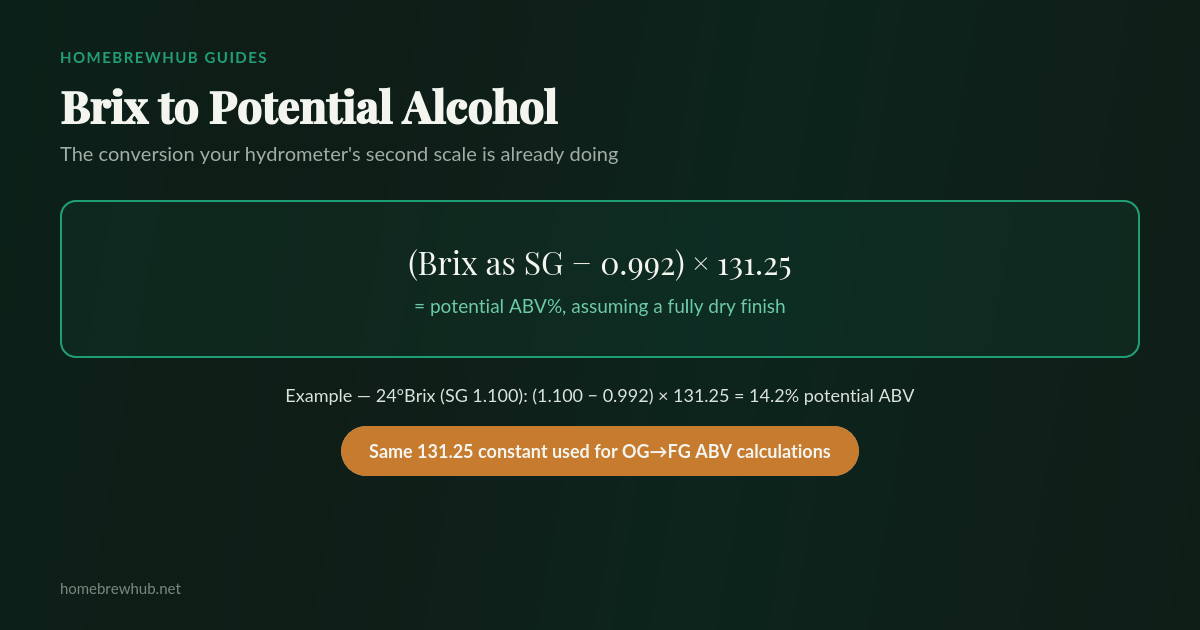
To convert a Brix reading into potential alcohol: potential ABV = (Brix converted to specific gravity − 0.992) × 131.25. For example, a must at 24°Brix (SG 1.100) has a potential alcohol of (1.100 − 0.992) × 131.25 ≈ 14.2% ABV, assuming complete fermentation to dryness.
Where this formula actually comes from
Brix measures dissolved solids by weight percentage — mostly sugar in a grape must. To find potential alcohol, that Brix value first needs converting to specific gravity (a standard, fixed physical conversion based on sucrose solution density), and then run through the same alcohol formula already used everywhere in home winemaking: ABV = (OG − FG) × 131.25.
The only difference here is that FG is being estimated rather than measured directly — assumed to land around 0.992, a typical finishing gravity for a wine fermented fully dry.
Brix to specific gravity reference table
| °Brix | Specific Gravity | Potential ABV |
|---|---|---|
| 15 | 1.061 | 9.1% |
| 20 | 1.083 | 11.9% |
| 22 | 1.091 | 13.0% |
| 24 | 1.100 | 14.2% |
| 25 | 1.105 | 14.8% |
The 0.992 assumption only holds for a fully dry fermentation. If you're planning to stop fermentation early for a sweeter wine, or fermenting a strain with lower attenuation, the true finishing gravity — and therefore the real ABV — will land higher than this formula predicts.
Worked example
For a must reading 24°Brix (converts to SG 1.100):
(1.100 − 0.992) × 131.25 = 14.2% potential ABV
Why refractometers and hydrometers can disagree once fermentation starts
A refractometer measures light refraction, which alcohol also affects — meaning a refractometer reading taken mid-fermentation needs a correction factor to stay accurate. A hydrometer measures actual density directly and doesn't have this problem, which is why most winemakers switch to a hydrometer once fermentation is underway, reserving the refractometer for the initial Brix reading on fresh must.
Skip the manual math
The wine calculator converts any Brix or SG reading into potential alcohol automatically, and tracks it against your actual fermentation as it progresses.
For the full picture on must chemistry, sugar/acid balance, and chaptalization, see Home Winemaking Science, Chapter 01.
This formula estimates potential alcohol from a starting Brix reading — it doesn't replace a hydrometer reading of your actual finished wine, which will always be more accurate than any calculation based on the original must alone.