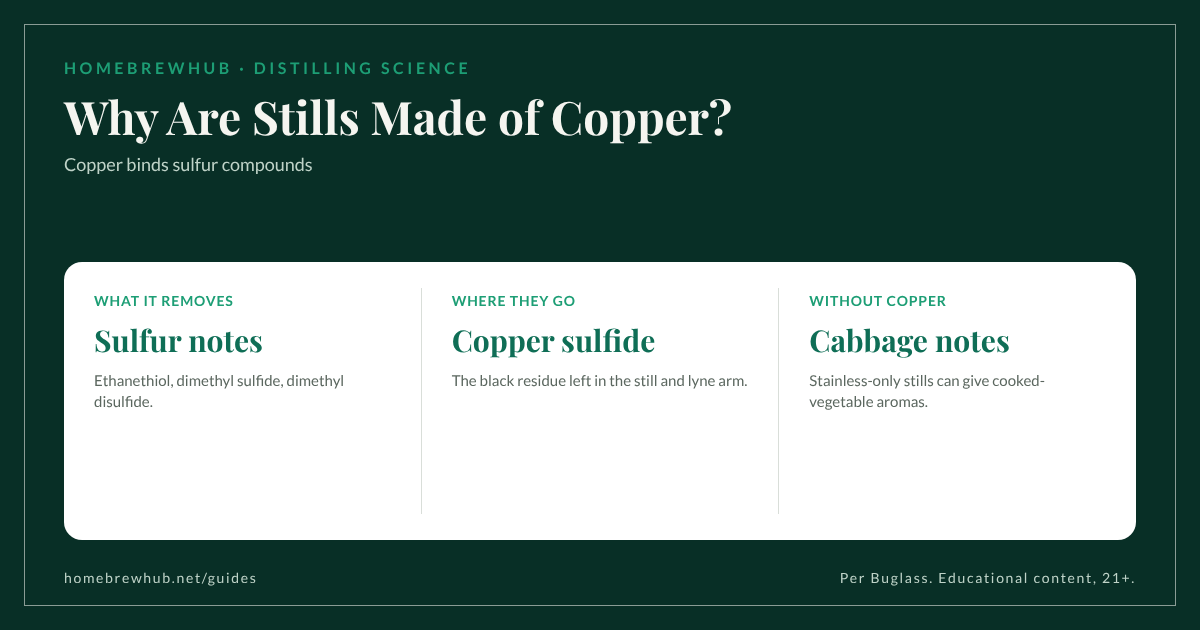
Because copper removes foul-smelling sulfur compounds from the spirit. Copper reacts with sulfur compounds that come from the grain and from fermentation, such as ethanethiol, dimethyl sulfide and dimethyl disulfide, and holds them back as copper sulfide. Without that contact, distillate can carry cooked-vegetable and cabbage notes. Copper was valued first for being easy to shape and heating evenly; the sulfur chemistry was understood much later.
What does copper actually do inside a still?
The mechanism is easy to see in bourbon stills, according to Buglass. Part of the residue left in the still and lyne arm is black: that's copper(II) sulfide, formed when the copper surface reacts with sulfur compounds and holds them back. After distillation, the remaining sulfur compounds either stay below their odor thresholds or, in small amounts, even add to the aroma.
Cachaça trials agree: copper stills, and aluminium stills with copper inserts, produced spirit with less dimethyl sulfide.
Copper binds sulfur compounds that would otherwise give the spirit a cooked-cabbage smell. But copper doesn't replace proper operation: ethyl carbamate stays lowest with low distillation temperatures and high reflux.
Why was copper used before anyone understood this?
According to Buglass, copper was first valued for its malleability, durability and heat conductivity: a copper still heats evenly and scorches less. As early as the nineteenth century it was known that copper stills gave better spirit than steel ones. The reason, sulfur removal, was found later.
Can a still be made of stainless steel?
Yes, but usually not without copper somewhere. According to Buglass, distillate from stills made entirely of stainless steel can carry overly pronounced cooked-vegetable and cabbage notes. So columns for bourbon are either hybrids, a stainless steel shell with copper internals, or entirely stainless steel with pieces of copper tubing placed inside. Smiley gives the same advice for home stills: even in a glass or stainless steel still, copper should be present at least in the packing.
What does copper cost?
| Issue | What the sources say |
|---|---|
| Wear | A Scotch pot still lasts 10–20 years; the bottom half of a wash still lasts twice as long as the top half, and the reverse for a spirit still (Buglass) |
| Copper loss | About 1 kg a day leaves a distillery such as Talisker in its distillation waste, by an estimate Buglass cites |
| Ethyl carbamate | Copper is involved in its formation under certain conditions; in a study of cachaça from 28 distilleries, the lowest level came from a stainless steel pot still, but copper stills run at low temperatures with high reflux also gave low levels |
For that last reason, stills for fruit spirits, where the vapors may contain cyanide compounds, use a catalytic converter with copper packing between the column and the condenser: ethyl carbamate forms there and is separated from the heart.
How the shape and type of still change the spirit: Pot Still vs Column Still. Wash profiles for 16 spirits: the Spirits catalog.
Still design, explained
Home Distilling Science, Chapter 6, covers the pot still, columns, copper and its costs, and stills for gin. Chapter 11 covers fire safety around a still.
Educational content about the science of distillation. Distilling spirits at home without a license is illegal in many countries, including the United States. Check the law where you live. This guide does not give still settings or cut points. Full disclaimer