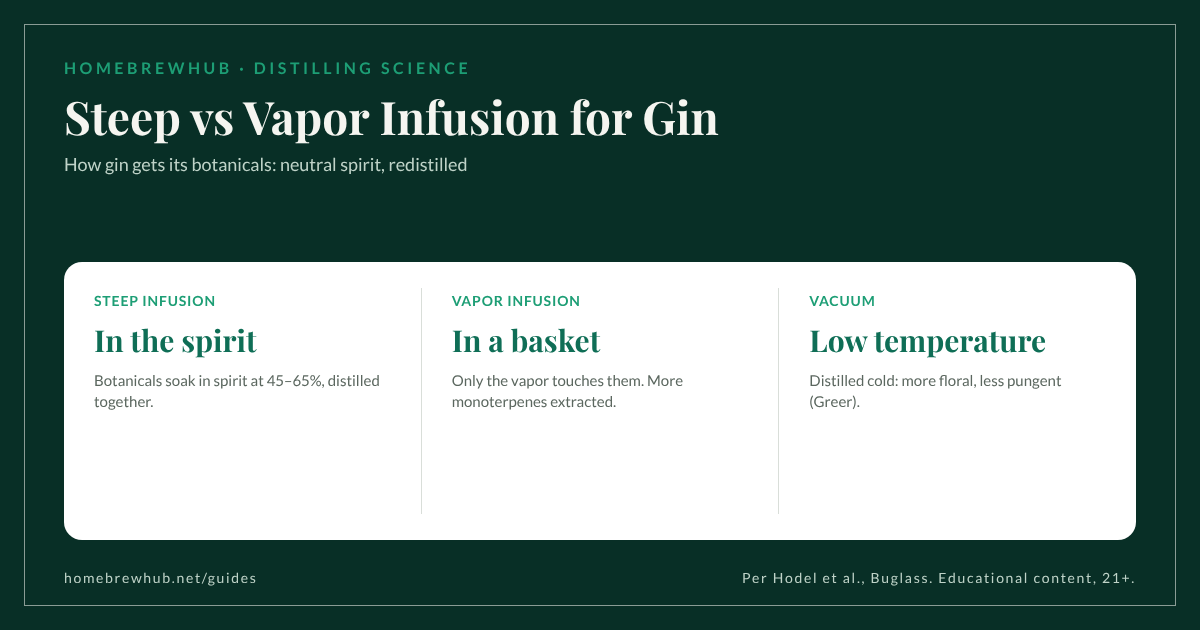
Gin is neutral spirit redistilled with botanicals, and the botanicals meet the spirit in one of two ways. In steep infusion, juniper and other botanicals soak in the spirit and everything is distilled together. In vapor infusion, the botanicals sit in a basket and only the vapor passes through them. A third route, vacuum distillation, distills at a much lower temperature and changes the aroma again.
What is steep infusion?
According to Hodel and co-authors, juniper and other botanicals are steeped in neutral spirit, usually diluted to 45–65%, and the whole charge is distilled together, typically in copper pot stills. The botanicals stay in contact with the hot liquid for the whole run.
What is vapor infusion?
The botanicals sit in a basket or chamber, either inside the still or outside it before the condenser, and the vapor passes through them without touching the liquid. According to Pauley and Maskell, the basket is built into the still head or the lyne arm. Finished gin distillate is usually about 80% alcohol.
Experimental data on vapor infusion are scarce. Hodel and co-authors studied which parameters affect it: the amount of botanicals per liter of charge had the greatest influence on the extraction of aroma compounds, and the strength of the charge the least, except for one compound, terpinen-4-ol. In a comparison they cite, vapor infusion extracted more monoterpenes than steep infusion.
In vapor infusion, the amount of botanicals per liter of charge matters most for aroma; the strength of the charge matters least. Vapor infusion extracted more monoterpenes than steep infusion in the comparison Hodel and co-authors cite.
Why is some gin distilled under vacuum?
Under reduced pressure a liquid boils at a lower temperature. According to Buglass, conventional distillation of a juniper and botanical maceration at around 80°C (176°F) alters the aroma profile, forming terpenes that weren't present in the original botanicals. Greer and co-authors distilled the same mixture at 0°C (32°F) and a pressure below 0.1 mm Hg. The distillate contained up to five times less monoterpenoids in some cases, and tasters judged the resulting gin more floral and pleasant, while the conventional gin was more pungent and spicy. Gentler regimes exist too: Buglass's example gin recipe runs under a shallow vacuum, by his estimate at about 60°C (140°F).
| Method | Where the botanicals are | Effect on aroma |
|---|---|---|
| Steep infusion | Soaked in the spirit, distilled with it | Botanicals in hot liquid for the whole run |
| Vapor infusion | In a basket in the vapor path | More monoterpenes extracted in the cited comparison |
| Vacuum distillation | Distilled at low temperature | More floral, less pungent in Greer's tasting |
The Gin wash profile in the Spirits catalog lists the botanicals per liter of charge from Hodel's work and scales them to your batch (Spirits Pro). Bringing gin to bottling strength: the free Proofing / Dilution calculator.
Stills for gin, and everything else
Home Distilling Science, Chapter 6, covers the basket and the vacuum, along with pot stills, columns and copper. Chapter 1 covers the raw materials behind neutral spirit.
Educational content about the science of distillation. Distilling spirits at home without a license is illegal in many countries, including the United States. Check the law where you live. This guide does not give still settings or cut points. Full disclaimer