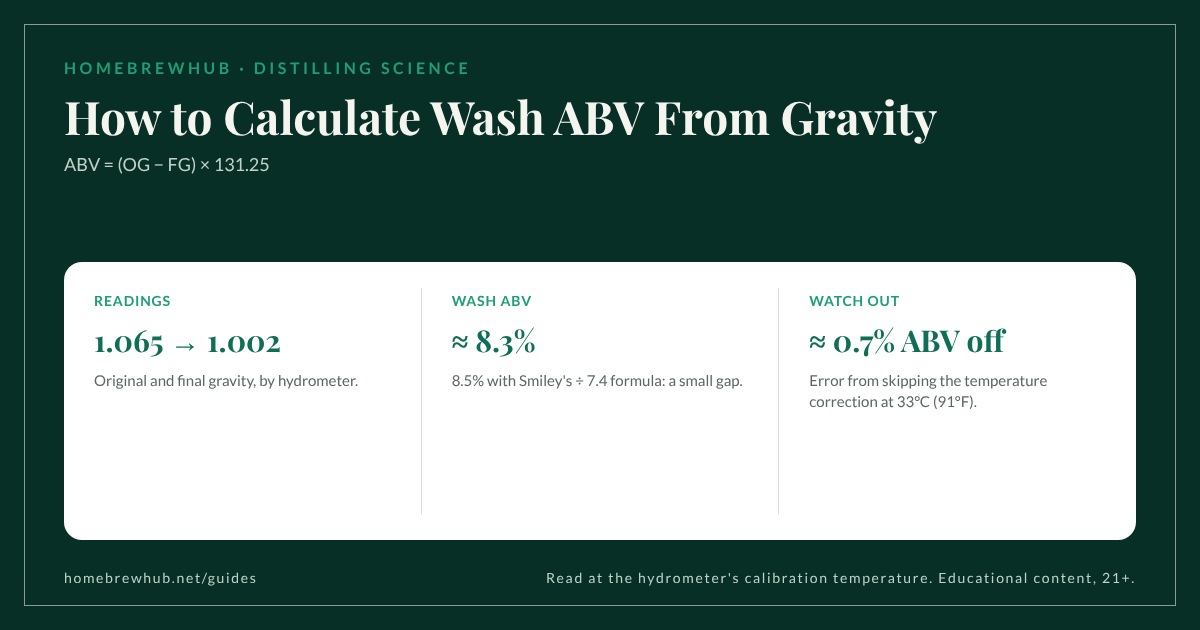
Subtract the final gravity from the original gravity and multiply by 131.25. A wash that starts at 1.065 and finishes at 1.002 comes out at about 8.3% ABV. Smiley and Miller use a slightly different formula, (OG − FG) × 1000 ÷ 7.4, which gives 8.5% for the same readings. The gap between the formulas is smaller than the error from reading a hydrometer at the wrong temperature.
Which formula should you use?
ABV (%) = (OG − FG) × 131.25 (the standard homebrewing formula)
ABV (%) = (OG − FG) × 1000 ÷ 7.4 (Smiley and Miller)
| Readings | × 131.25 | × 1000 ÷ 7.4 |
|---|---|---|
| OG 1.065, FG 1.002 | 8.3% | 8.5% |
| OG 1.060, FG 1.000 | 7.9% | 8.1% |
| OG 1.070, FG 1.005 | 8.5% | 8.8% |
Either is fine for a wash. To know how much alcohol the wash holds, multiply its volume by the ABV: 25 L at 8.3% holds about 2.07 L of pure alcohol.
Why does the reading temperature matter so much?
Most hydrometers are calibrated at 15.5°C (60°F), and liquid gets lighter as it warms. Smiley's example: a sample at 33°C (91°F) reading 1.060 needs a correction of +0.005 from the table, so the true gravity is 1.065. Skip the correction and the calculated strength is off by about 0.7% alcohol, more than the difference between the two formulas.
Read gravity at your hydrometer's calibration temperature, or correct it with the table. The temperature correction matters more than which ABV formula you use.
Can you use a refractometer instead of a hydrometer?
Only for the original reading. A refractometer needs just a few drops and isn't bothered by suspended mash solids, so it works well before fermentation. Smiley converts roughly with SG = °Brix ÷ 250 + 1. But once alcohol is present, refractometer readings are skewed, so readings during and after fermentation need a correction, or a hydrometer.
What original gravity should a wash start at?
For a home grain mash, Smiley and Miller both give 1.060–1.070. Below 1.060 the wash still ferments, just with less alcohol; above 1.070, alcohol during fermentation climbs past 10%, which in their view can affect flavor. Scotch malt wash, according to Walker and Hill, typically carries 8–10% alcohol.
How do you know the wash is ready?
Miller looks for vigorous fermentation slowing to occasional bubbling and gravity at 1.015 or below. Smiley takes a reading about every 12 hours: when it has nearly stopped changing, fermentation is done. Final gravity can land below 1.000, because alcohol is lighter than water and almost no sugar is left.
The free Wash Recipe & ABV calculator takes OG as SG or °Brix and gives the ABV and the pure alcohol in your wash. Wash profiles for 16 spirits are in the Spirits catalog.
Temperature, gravity and knowing when it's done
Home Distilling Science, Chapter 4, covers fermentation temperature, original gravity for every raw material, measuring and calculating, and what to do when a fermentation goes wrong.
Educational content about the science of distillation. Distilling spirits at home without a license is illegal in many countries, including the United States. Check the law where you live. This guide does not give still settings or cut points. Full disclaimer