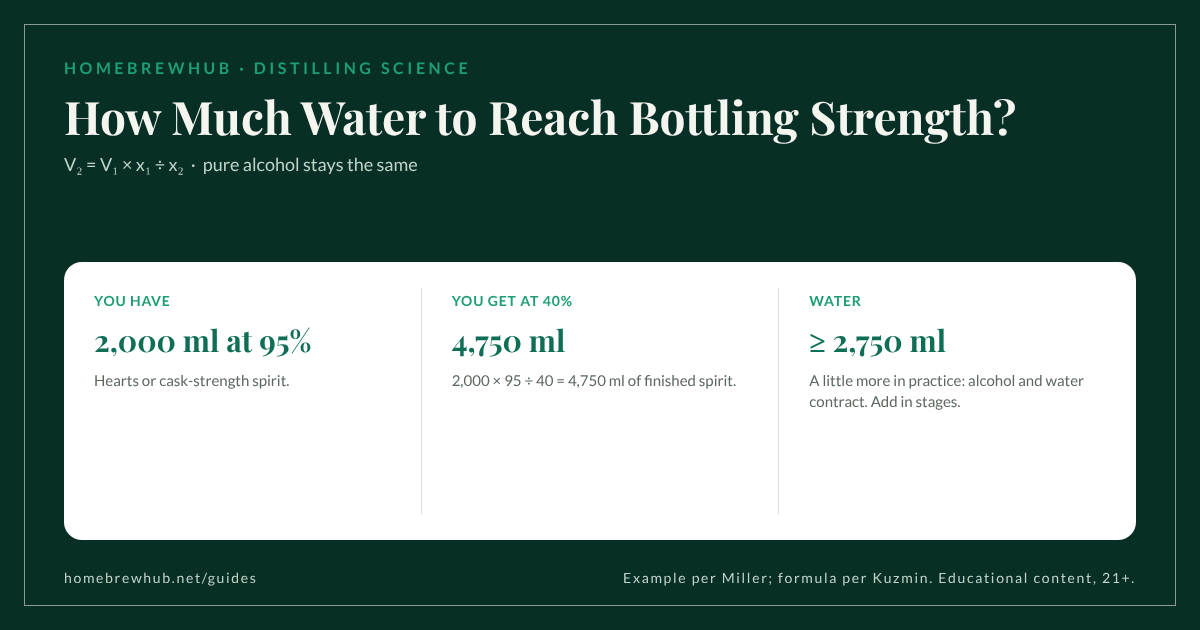
Use the alcohol balance: finished volume = starting volume × starting strength ÷ target strength. The amount of pure alcohol doesn't change when you add water, so 2,000 ml of spirit at 95% makes 4,750 ml at 40%, which means at least 2,750 ml of water. Because alcohol and water shrink when mixed, you'll end up pouring a little more than that, so add the water in stages and check the strength as you go.
What is the formula for diluting spirit with water?
V₁ × x₁ = V₂ × x₂, so V₂ = V₁ × x₁ ÷ x₂. V₁ and x₁ are the volume and strength of the spirit you have; V₂ and x₂ are the volume and strength you want. The water to add is at least V₂ − V₁.
This is the balance equation as Kuzmin writes it. Miller's worked example: 2,000 ml of spirit at 95%, target 40%. Finished volume = 2,000 × 95 ÷ 40 = 4,750 ml. Water by the formula = 4,750 − 2,000 = 2,750 ml.
| You have | Target | Finished volume | Water (minimum) |
|---|---|---|---|
| 2,000 ml at 95% | 40% | 4,750 ml | 2,750 ml |
| 1,000 ml at 60% | 40% | 1,500 ml | 500 ml |
| 1,000 ml at 70% | 55% | about 1,273 ml | about 273 ml |
Why do you need more water than the formula says?
Because of contraction. When alcohol and water are mixed, the mixture takes up less volume than its parts did separately. According to Kuzmin, the effect grows with strength, peaks at 53–56%, and then declines. The balance equation still gives the finished volume correctly; it's the water you actually pour that ends up somewhat larger than V₂ − V₁. That's why water goes in over several stages rather than all at once, with the strength checked before the last addition.
When should you measure the strength after diluting?
Not right away. Mixing alcohol and water releases heat: according to Kuzmin, the most heat comes at about 36% strength, and the temperature rises by 5–10°C (9–18°F) by various accounts, while 6–8% of dissolved air comes out. A spirit hydrometer is calibrated at a specific temperature, 20°C (68°F) per Miller or 15.56°C (60°F) per Smiley, so check your instrument and measure only after the mixture has cooled to it, or use the correction table that comes with the hydrometer.
The balance equation tells you exactly how much drink you'll get. Contraction means you'll use more water than the difference in volumes, and the mixture warms as you dilute. Add water in stages and measure only at the hydrometer's calibration temperature.
How do you avoid cloudiness when diluting?
Haze has two sources. Hard water leaves a white precipitate, harmless but unsightly, so Miller advises water without calcium, magnesium or chlorine, tested first on a small amount of spirit. And below about 45%, some compounds in the spirit itself (fusel oils, esters, terpenes) can drop out. Miller's technique: dilute to 55% first, then add the remaining water slowly; in her experience that gives practically no haze down to at least 43%. Pour the water into the spirit, not the other way around, and mix slowly.
What strength are spirits bottled at?
| Spirit | Typical bottling strength | Source |
|---|---|---|
| Scotch whisky | 40%, 43% or 46% | Buglass |
| Scotch whisky, cask strength | about 58% | Buglass |
| Brandy, Cognac | about 43% | Buglass |
| Cachaça (Brazilian standards) | 38–48% | Cachaça review |
| Home corn whiskey | 40–50% | Smiley |
If the spirit is going into oak, don't dilute it to drinking strength first. The sources point to partial dilution (Miller recommends 55–62% for home whiskey), aging, and only then final dilution.
The free Proofing / Dilution calculator does this math for your volume and strengths. For blending two spirits to a target strength, use Blend Ratio (Pro).
The math of strength
Home Distilling Science, Chapter 9, covers the balance equation, contraction, when to dilute, haze and blending. Chapter 2 covers the water itself.
Educational content about the science of distillation. Distilling spirits at home without a license is illegal in many countries, including the United States. Check the law where you live. This guide does not give still settings or cut points. Full disclaimer