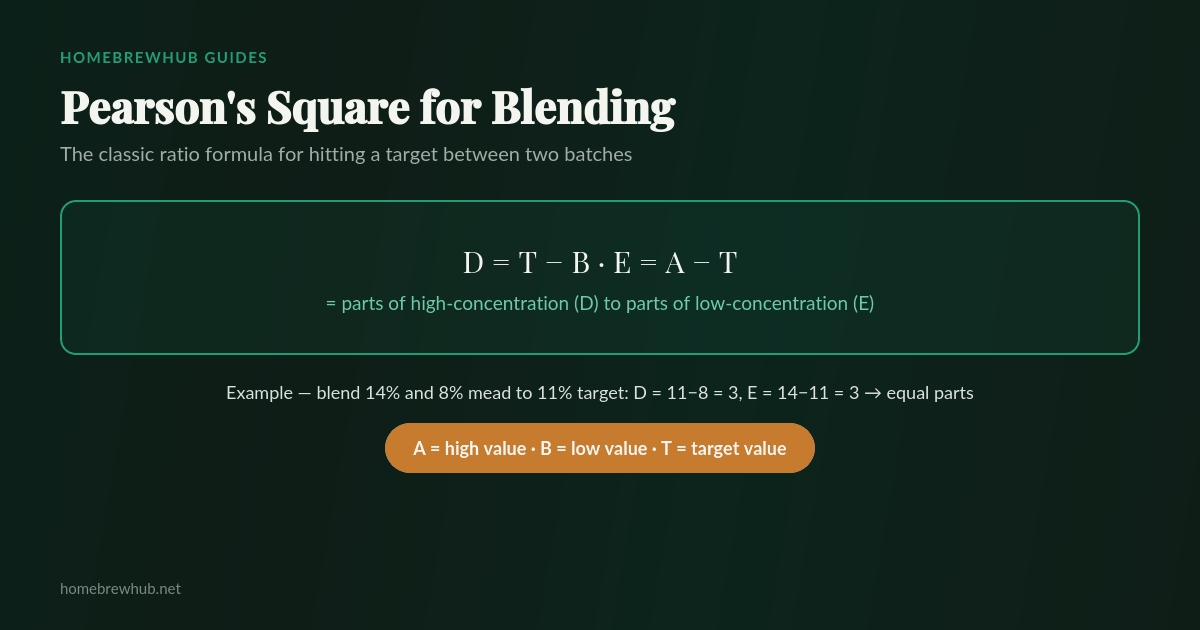
To blend two meads to a target ABV using Pearson's Square: D = target − low value, and E = high value − target. D and E give the ratio of parts of the high-concentration mead to parts of the low-concentration mead. For example, blending a 14% and an 8% mead to an 11% target gives D = 11−8 = 3 and E = 14−11 = 3 — equal parts of each.
What Pearson's Square actually is
Pearson's Square is a simple diagonal-subtraction method for finding a blend ratio between two values to hit a target in between them. It's not specific to mead — the same technique works for blending wine, juice, or any two liquids where you're targeting a value that blends roughly linearly by volume.
D = T − B
E = A − T
Where A is the high-concentration value, B is the low-concentration value, T is your target, D is the number of parts of the high-concentration batch, and E is the number of parts of the low-concentration batch.
Worked example
Say you have 5 gallons of a mead at 14% ABV and 5 gallons at 8% ABV, and you want a batch that lands at 11%:
D = 11 − 8 = 3 parts of the 14% mead
E = 14 − 11 = 3 parts of the 8% mead
Since D and E come out equal, this is a 1:1 blend — equal volumes of each mead gets you to 11% ABV.
Pearson's Square isn't limited to ABV. The same formula works for blending toward a target sweetness, acidity, or color — anywhere you have two known values and want a specific point between them.
Rough cuts, then fine-tuning
Pearson's Square gets you to a mathematically correct ratio, but taste is still the final judge. A practical approach: prepare small trial blends at several ratios around your calculated target (say, in 20% steps first, then narrowing to 5% steps around whichever trial tastes best), tasting each before committing to a full batch. What reads as "correct" on paper doesn't always read as best on the palate — especially once flavors continue melding together over the following weeks of aging.
Before blending, make sure both batches have completely finished fermenting and are stable. If either hasn't fermented out to its yeast's alcohol tolerance, the blend risks restarting fermentation — treat with potassium sorbate first, or confirm gravity has been stable for several days.
Plan your blend
Use the mead calculator to check each batch's actual ABV first, then apply Pearson's Square to find your exact blending ratio.
For the full picture on blending technique, rough-cut and fine-tune trial ratios, and aging blended meads, see Home Meadmaking Science, Chapter 9.
Pearson's Square assumes the target property blends linearly by volume, which holds reasonably well for ABV in similar liquids but can drift for more complex characteristics like perceived sweetness. Always confirm with a small trial blend before committing a full batch.