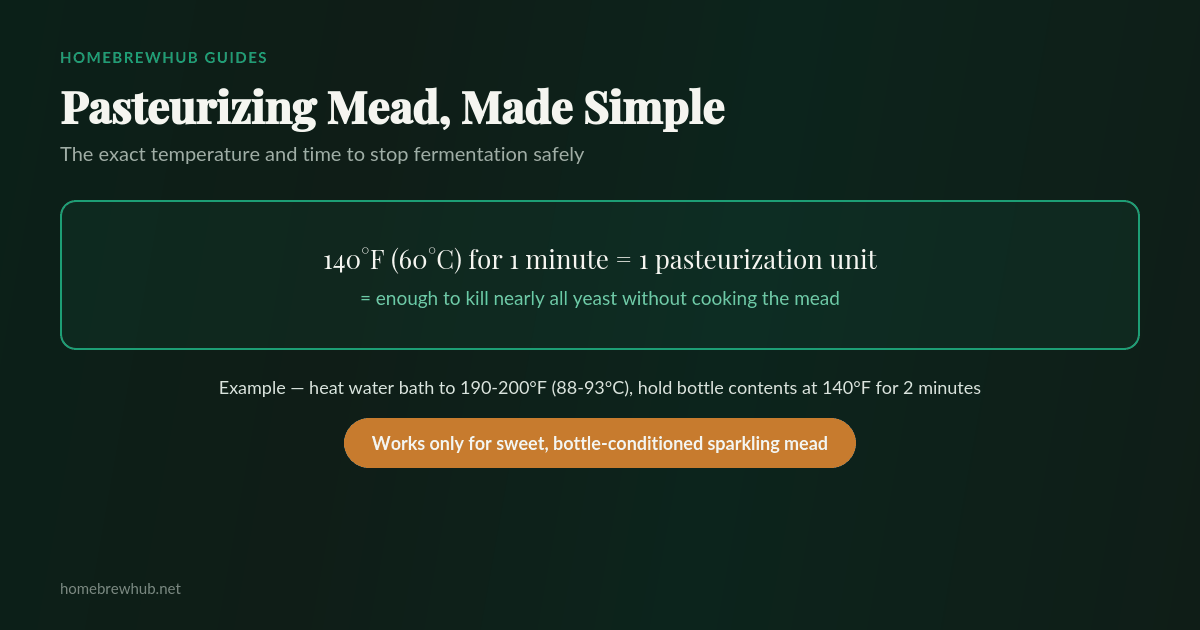
To pasteurize mead: heat the bottled mead to 140°F (60°C) and hold it there for 1 minute — this equals one pasteurization unit, generally sufficient to kill nearly all yeast without noticeably cooking the mead. A hot water bath heated to 190–200°F (88–93°C) is typically used to bring the bottle's contents up to that internal temperature.
What pasteurization is actually for here
This technique is specifically for sweet, bottle-conditioned sparkling mead — batches deliberately bottled while still fermenting, so carbonation builds up naturally inside the sealed bottle. Left alone, that same fermentation would eventually consume all the remaining sugar, leaving a mead that's both fully dry and dangerously overcarbonated. Pasteurization stops fermentation right where you want it — sweet, and carbonated, but not still fermenting.
The home process
- Use strong bottles built for this — returnable-style beer bottles or champagne bottles handle the thermal shock far better than standard wine bottles
- Heat a water bath to 190–200°F (88–93°C) in a covered pot
- Place several filled bottles in the water, plus one open bottle with a thermometer inserted, to monitor internal temperature
- Once the thermometer reads 140°F (60°C), wait a couple of minutes, then remove the bottles
- Transfer bottles to a pot of cool (not cold) water to bring them back down to storage temperature gradually
Exact timing is hard to predict from a formula alone — pot size, water temperature, bottle weight, starting bottle temperature, and cooling bath temperature all affect how long the process actually takes. Running it on a few test bottles first lets you build a repeatable system for your specific setup.
Monitoring carbonation before you pasteurize
Since pasteurization is meant to lock in a specific carbonation level, you need to check periodically as the bottles condition — opening a test bottle occasionally to gauge how much fizz has developed — and pasteurize once it reaches the level you're after, rather than on a fixed schedule.
If pectin is still present in the mead, pasteurization can introduce a slight haze, and the heat treatment itself may cause a small amount of flavor and aroma degradation. Neither is usually severe, but it's worth knowing pasteurization isn't entirely without trade-offs.
Plan your stabilization method
The mead calculator's Stabilization tool covers pasteurization alongside sulfite/sorbate stabilization, so you can compare approaches for your batch.
For the full picture on stopping fermentation early — including chilling and sterile filtration as alternatives — see Home Meadmaking Science, Chapter 8.
Pasteurizing sealed, pressurized bottles carries a real risk of bottle failure from thermal shock — use bottles rated for this purpose, handle them carefully, and never pasteurize a bottle you suspect is already overcarbonated.