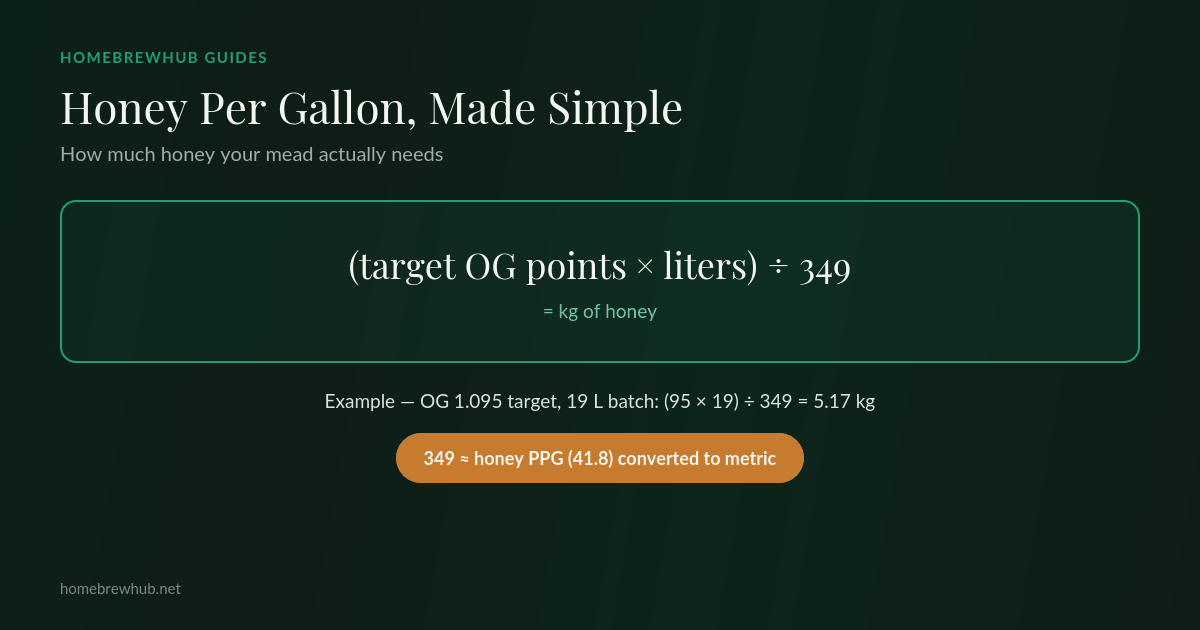
To calculate honey dosage for mead: kilograms of honey = (target OG points × batch volume in liters) ÷ 349. For example, a 19 L batch targeting an original gravity of 1.095 needs (95 × 19) ÷ 349 ≈ 5.17 kg of honey.
What's the honey dosing formula?
Honey's fermentable sugar content converts to gravity points at a fairly consistent rate — commonly expressed in homebrewing as PPG, or points per pound per gallon. Averaged across several real, published mead recipes at different strengths, honey works out to approximately 41.8 PPG. Converting that imperial figure to metric units (kilograms and liters) gives a single constant: 349.
kg of honey = (target OG points × liters) ÷ 349
Where "OG points" means the original gravity minus 1, multiplied by 1000 — so a target OG of 1.095 is 95 points, and a target OG of 1.120 is 120 points.
The 349 constant was checked against four independent published mead recipes at different honey weights and batch sizes (9.5 lb honey / 5 gal → OG 1.080; 14 lb / 5 gal → OG 1.115; 14.5 lb / 5 gal → OG 1.122; 15.5 lb / 3.16 gal pre-fruit → OG 1.206). Each one independently worked out to a PPG between 41.1 and 42.1 — a tight enough spread to treat 41.8 as a reliable average.
Worked example
Say you're making a 19 L (5 gal) batch of a Standard-strength traditional mead, targeting an original gravity of 1.095:
(95 × 19) ÷ 349 = 5.17 kg of honey
Dissolve the honey into part of your treated water first — roughly twice the water's volume relative to the honey makes it easier to fully dissolve — then top up to your full batch volume before pitching yeast.
Why calculate by weight instead of using a fixed ratio
A rule of thumb like "1 kg of honey per 3-4 L of water" is a reasonable starting point for a Standard-strength mead, but it doesn't scale correctly across styles. A light Hydromel (3.5-7.5% ABV) and a strong Sack mead (14-18% ABV) call for very different honey concentrations in the same batch volume — calculating from your actual target OG avoids guessing which ratio applies to which style.
Honey itself has a density of roughly 1.44 kg per liter — heavier than water. That means the honey you add doesn't fully add its own volume to the batch: for every kilogram of honey dissolved, expect the total batch volume to grow by only about 0.7 liters, not a full liter. Account for this when topping up to your final target volume.
Skip the manual math
The mead calculator applies this formula directly to any of the 27 catalog recipes, scaled to your batch size — no separate conversion needed.
For the full picture on honey varieties, crystallization, and how honey choice shapes the finished mead, see Home Meadmaking Science, Chapter 1.
This formula estimates honey weight from target gravity — it doesn't account for a hydrometer reading of your actual must, which will always be more accurate than any calculation. Take a gravity reading before pitching yeast to confirm you've hit your target.