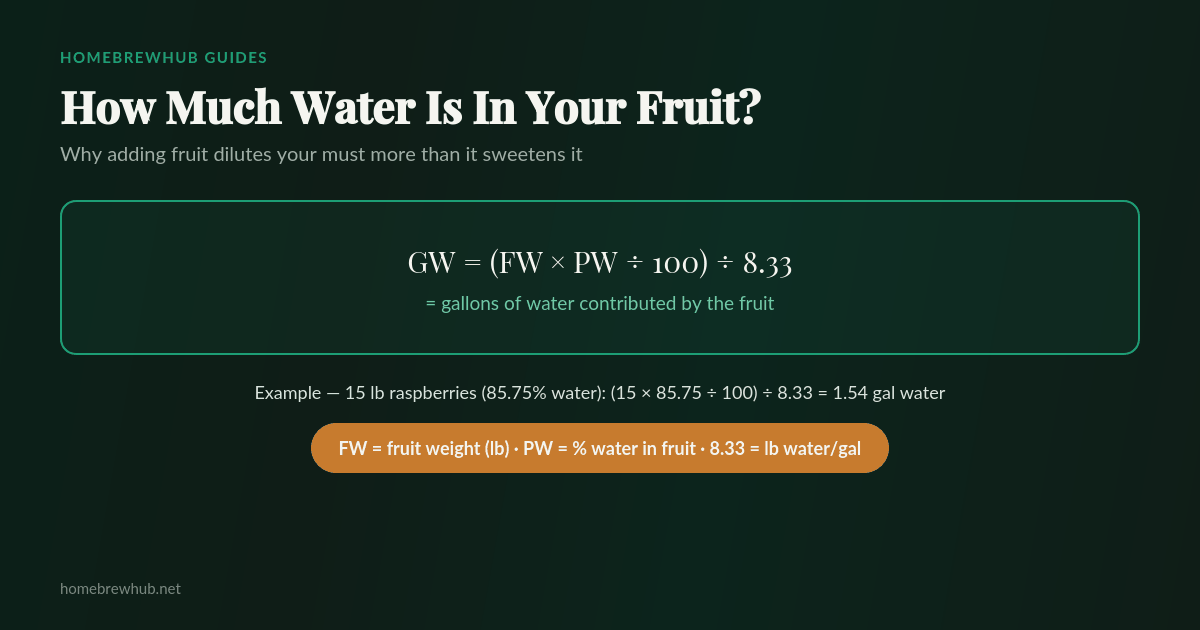
To calculate how much water a fruit addition contributes to a melomel: gallons of water = (fruit weight in pounds × percent water in the fruit ÷ 100) ÷ 8.33. For example, 15 pounds of raspberries (about 85.75% water) contributes (15 × 85.75 ÷ 100) ÷ 8.33 ≈ 1.54 gallons of water to the must.
Why fruit dilutes more than it sweetens
Most fruit is somewhere around 80–90% water by weight. The rest is mostly fermentable sugar, but in far smaller quantities than people expect — meaning a large fruit addition changes your batch's water volume more than it changes its sugar content. Ignore this, and your melomel can finish noticeably drier than planned, simply because the honey-derived sugar got diluted by water nobody accounted for.
What's the water contribution formula?
gallons of water = (fruit weight in lb × percent water in fruit ÷ 100) ÷ 8.33
Where 8.33 is the weight of a gallon of water in pounds (3.78 kg per liter). Percent water content varies by fruit — raspberries run around 85.75%, and most berries and stone fruit fall in a broadly similar 80–90% range, though exact figures vary by variety and ripeness.
In a real worked example: 15 lb of raspberries added to 5 gallons of 1.130 OG must contributes about 1.54 gallons of water, but only around 0.66 lb (300 g) of actual fermentable sugar. The net effect is roughly equivalent to starting the batch at OG 1.092 instead of 1.130 — a meaningfully drier mead than the pre-fruit reading alone would suggest.
Worked example
For 15 lb of raspberries added to a batch:
(15 × 85.75 ÷ 100) ÷ 8.33 = 1.54 gallons of water contributed
To hit a specific target OG after fruit, calculate your honey-water base to land higher than your true target — accounting for the dilution the fruit will add once it releases its water into the must.
Why you can't just check gravity right after adding fruit
Most fruit doesn't release its water immediately when added whole to a must. A hydrometer reading taken right after dropping in fresh or frozen fruit won't reflect the true diluted gravity — it takes time (and often some maceration or freeze-thaw breakdown) for the fruit to release its juice fully into the batch.
Most fruit contains pectin, the same substance that gels jam. Left unaddressed, pectin in a melomel can cause a persistent haze that's difficult to clear later — and heating fruit that contains pectin makes this worse, since heat encourages the pectin to gel. A pectinase enzyme addition at the same time as the fruit heads this off before it becomes a clarity problem.
Skip the manual math
The mead calculator's Recipe Builder scales any of the catalog's melomel recipes to your batch size, accounting for fruit dilution automatically.
For the full picture on fruit selection, processing, and pectin management across melomel styles, see Home Meadmaking Science, Chapter 9.
Percent water content varies by fruit variety, ripeness, and growing conditions — treat the figures here as a practical starting estimate, and confirm your actual gravity with a hydrometer once the fruit has had time to release its juice into the must.