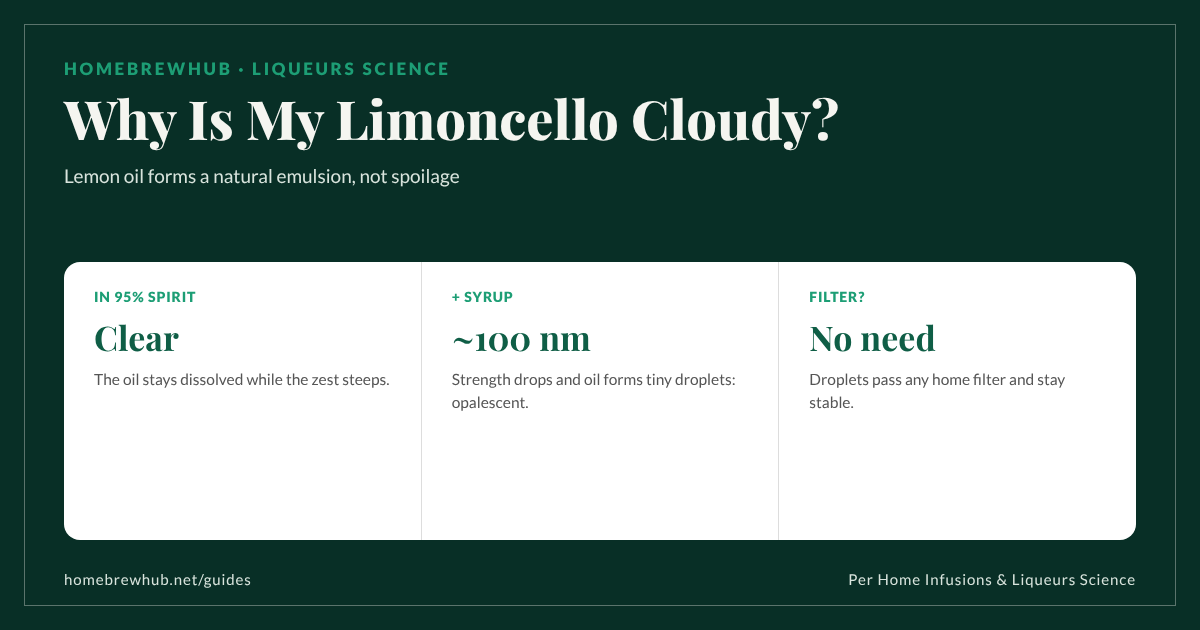
Limoncello turns milky when the syrup goes in because lemon essential oils come out of solution. The oils dissolve well in strong spirit, so the zest steep in 95% spirit stays clear. Syrup lowers the strength, and part of the oil drops out as droplets of about 100 nanometers: small enough to stay suspended for a long time and to pass through any home filter. That opalescent yellow is a normal, stable emulsion, not a sign of spoilage.
Why does lemon oil cloud the liqueur?
The main components of lemon oil hardly dissolve in water. Hodel, citing Cháfer and co-authors, gives the strength above which they stay dissolved in a water-ethanol mix: limonene above about 78.6% ABV and linalool above about 46% ABV. Below those thresholds some of the oil can no longer stay in solution. A limoncello steep made with 95% spirit is above both, so it is clear. Once syrup brings the mix down to drinking strength, part of the oil separates into microscopic droplets.
Is it the same as the ouzo effect?
It is the same family of effect. In anise drinks the aroma compound anethole dissolves in high-proof alcohol and drops out as a fine suspension when water is added; the French call this the louche, and the scientific literature calls it the ouzo effect. The difference is droplet size. Chiappisi and Grillo (2018) give droplets of 500 nm to several micrometers for ouzo systems, while in limoncello they measured about 100 nm in every sample studied.
What did the limoncello research find?
| Observation | Finding |
|---|---|
| Droplet size | About 100 nm in all samples studied |
| Zest steep before dilution | With 15% water by weight, fully homogeneous (clear) |
| Typical good limoncello | About 50% water by weight; about a third of the oil stays dissolved |
| A lot of water | Above 60% water by weight, all the oil goes into droplets |
| Temperature | From −7 to 25°C (19-77°F) the structure does not change |
| Sugar | Sucrose up to 25% by weight does not change the structure |
After Chiappisi and Grillo (2018), as summarized in Home Infusions & Liqueurs Science, Chapter 7.
The same study made a "pseudo-limoncello" from water, sucrose, ethanol and lemon essential oil, with no zest steeped at all, and got the same droplet size. So the droplets are not held in place by proteins or other material from the peel; the oil mixture stabilizes itself. That is why the haze does not separate in the bottle the way a fruit sediment would.
Limoncello's milky color is the expected result of lemon oil meeting water. The dissolved part of the oil carries the aroma, and the droplets of about 100 nm give the opalescent look and long stability.
Can you filter limoncello clear?
Not at home, and there is no reason to. Cheesecloth and paper coffee filters hold back solid particles only; oil droplets of about 100 nm pass straight through. The filtering step in limoncello recipes, including the Limoncello card in the HomeBrewHub catalog (15 days of steeping in the dark, then 40 days of rest), is there to catch bits of zest, not to remove the color.
When is a cloudy liqueur a problem?
Oil haze is specific to citrus zest and anise. In fruit and spice liqueurs, haze usually comes from fine particles of the raw material, most often because the fruit was pressed to get more liquid. That kind of haze can be fixed: let the liqueur stand so the particles settle, then pour or siphon the clear part off the sediment, or strain it through two or three layers of damp cheesecloth. Nut liqueurs can show a film of oil on top, and cream liqueurs separate as the fat rises; both are put right by shaking the bottle.
One safety note for limoncello specifically: 95% spirit is for dilution only. Never drink it undiluted, keep it away from flames and hot stoves, and pour it into syrup that has cooled completely.
Work out the strength and sugar of your limoncello in the free Liqueur calculator, or browse the Liqueur Recipes catalog.
Haze, louche and filtration, in depth
Home Infusions & Liqueurs Science covers all three sources of haze and how to deal with each in Chapter 7; the Guide walks through a first limoncello in Chapter 3.
Educational content. Make and drink alcoholic beverages only if you are of legal drinking age where you live, and check local rules before making alcoholic drinks. Full disclaimer