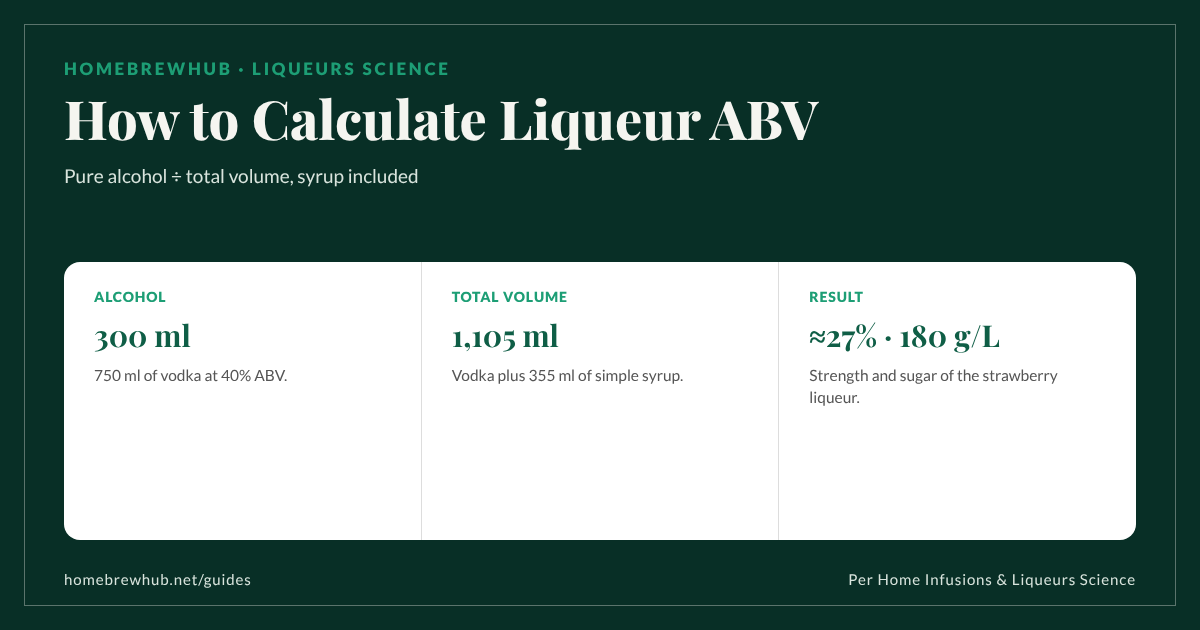
Add up the pure alcohol from every alcoholic ingredient, then divide by the total volume of the mix. Each spirit contributes its volume times its strength; the total volume includes the spirit, the syrup and any water. For example, 750 ml of 40% vodka with 355 ml of simple syrup holds 300 ml of ethanol in about 1,105 ml, which is about 27% ABV. Sugar works the same way: grams of sugar divided by liters of finished drink, here about 180 g/L.
What is the formula for liqueur ABV?
It is the alcohol balance used for diluting spirits (V₁ × C₁ = V₂ × C₂), extended to several ingredients:
ABV = sum of (volume × strength of each alcoholic ingredient) ÷ total volume of the mix
Sugar, g/L = grams of sugar in the mix ÷ total volume in liters
Count the volume of the sugar. In a syrup it is already included in the syrup's volume. If you dissolve sugar directly into the recipe instead, add about 0.62 ml for every gram of sugar, a figure taken from the NBS C457 density tables for sugar solutions.
A worked example: strawberry liqueur
The Fresh Strawberry Liqueur in the HomeBrewHub catalog uses 750 ml of vodka at 40-50% and 1½ cups (about 355 ml) of simple syrup made from equal volumes of sugar and water. The strawberries are strained out.
| Step | Calculation | Result |
|---|---|---|
| Ethanol from 40% vodka | 750 ml × 0.40 | 300 ml |
| Ethanol from 50% vodka | 750 ml × 0.50 | 375 ml |
| Sugar from the syrup | 355 ml of simple syrup | About 197 g |
| Total volume | 750 + 355 ml | About 1,105 ml |
| Strength | 300 to 375 ÷ 1,105 | About 27-34% ABV |
| Sugar | 197 g ÷ 1.105 L | About 180 g/L |
Worked example from Home Infusions & Liqueurs Science, Chapter 6.
At about 180 g of sugar per liter, this is a liqueur in the legal sense too: EU Regulation 2019/787 requires a liqueur to contain at least 100 g of sweetening per liter at a strength of at least 15% ABV.
What does the calculation leave out?
- Water and sugar from the fruit. Fruit releases juice into the steep, and the amount depends on the fruit and the steeping time, so it is not counted. The real strength of a fruit liqueur is usually a little lower than calculated, and the sugar may be higher.
- Contraction. A mix of spirit and water takes up slightly less volume than its parts; according to the Kuzmin monograph the effect is greatest at 53-56% ABV. The calculation ignores it.
- Liquid held back by the fruit. Strained fruit keeps some of the steep, so you bottle less than the sum of the volumes. This changes the yield, not the strength or sugar.
The calculation tells you what kind of drink you are building, but it is an estimate. Taste still decides, and for fruit liqueurs the true strength usually sits a little below the number.
What strength and sugar are typical?
| Reference | Strength | Sugar |
|---|---|---|
| Traditional liqueurs (Lea and Piggott 1995) | 35-45% | - |
| 12 commercial limoncellos (Versari 2003) | 27-40% | 182-277 g/L |
| EU minimum for a "liqueur" | 15% | 100 g/L |
From Home Infusions & Liqueurs Science, Chapters 5 and 6.
How do you scale a liqueur recipe?
Work the recipe out per liter of finished drink, then multiply. Keeping the proportions of every ingredient keeps the strength and sugar the same at any volume. Steeping time does not scale with volume: it depends on the fruit, how finely it is cut and the strength of the spirit.
Skip the arithmetic: the Liqueur calculator does this balance for any mix of spirits, syrup and water. Build a Liqueur and Syrup are free; Hit a Target, Blend and Scale are Pro.
Building a liqueur, in depth
Home Infusions & Liqueurs Science covers strength, sugar and scaling in Chapter 6 and syrups in Chapter 5; the Guide shows how to add syrup in steps in Chapter 4.
Educational content. Make and drink alcoholic beverages only if you are of legal drinking age where you live, and check local rules before making alcoholic drinks. Full disclaimer