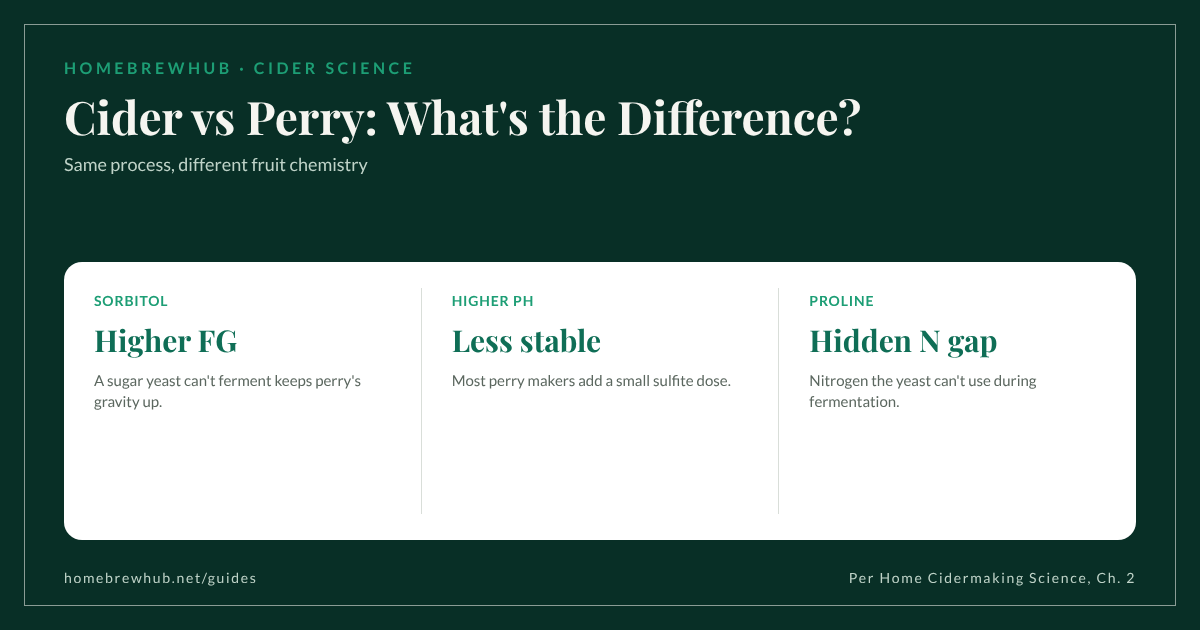
Perry is made from pears and cider from apples, and pear juice behaves differently in four ways that matter. It holds sorbitol, a sugar yeast can't ferment, so perry finishes at a higher gravity. It runs at a higher pH, so it is less microbiologically stable. Much of its nitrogen is proline, which yeast can't use during fermentation. And it is rich in procyanidins, so two clear perries can turn hazy when blended.
Which pears are used for perry?
Three kinds of fruit end up in perry, and mixing them up is an easy way to end up disappointed. True perry pears (Thorn, Barland, Plant de Blanc and dozens of similar cultivars) are high in acidity and tannin and were bred for the press. Dessert pears (Bartlett, Conference, Anjou) have lower acidity and no bitterness. Wild pears from old feral trees are unique and unpredictable.
| Variety | Acidity (g/L as malic) | True tannin (g/L) |
|---|---|---|
| Blakeney Red | 4.5 | 1.17 |
| Butt | 5.4 | 3.00 |
| Thorn | 5.7 | 0.47 |
| Moorcroft | 5.0 | 0.76 |
| Winnal's Longdon | 5.7 | 0.42 |
Perry pear juice data as summarized in Home Cidermaking Science, Chapter 2. Butt stands out at 3.00 g/L of tannin, far above the others, and a tasting panel found its perry noticeably astringent.
Why does perry finish at a higher gravity?
Pear juice contains a meaningful amount of sorbitol, an unfermentable sugar alcohol. Part of the gravity reading stays no matter what the yeast does, so perry's final gravity doesn't drop to the same values as cider's. That makes it harder to judge when fermentation has actually finished: watch for the gravity to stop changing rather than for a fixed number.
Why do perry makers use sulfite more often?
Pear juice typically runs at a higher pH than apple juice, which makes it microbiologically less stable. That's why most perry makers add a small sulfite dose even where they'd skip it for cider or wine, and why a "zero-zero" perry, with no sulfite at all, is considerably harder to pull off than an equivalent cider.
Why can perry ferment poorly even when the juice has nitrogen?
Total yeast-assimilable nitrogen across surveyed perry pear varieties runs noticeably lower than in cider apples. On top of that, proline is often the dominant amino acid in pear juice, and yeast can't use it under the anaerobic conditions of fermentation. In some varieties (Tumper, for instance) the juice holds almost no usable amino acids at all, even with plenty of proline. So "total amino nitrogen" on a lab report can badly overstate what the yeast actually gets.
Sorbitol keeps perry's gravity higher, a higher pH makes it less stable, proline nitrogen is largely unusable to yeast, and procyanidins can make two clear perries turn milky when blended. The process is the same as cider; the juice isn't.
Why did my blended perry turn cloudy?
Pears are rich in procyanidins, polyphenols that can bind together in unpredictable ways. Two perfectly clear perries can turn milky-opaque when blended, an effect cider and wine makers don't expect. The sediment can look strange but is harmless. Maceration before pressing, common in Austria, helps soften the effect.
Is perry harder to harvest and press?
Yes. Perry pear trees can grow up to 18 m (60 ft) tall, and some varieties won't drop their fruit on their own. The ripeness window is short: roughly 2 days for Thorn and just 24 hours for Moorcroft. Pears also clog mills and presses more than apples, and they don't float, which makes washing a harvest more work.
The Cider & Perry Styles catalog covers 16 BJCP styles, including perry. For nitrogen, see How Much Yeast Nutrient Does Cider Need?
Cider and perry, side by side
Home Cidermaking Science gives perry its own chapter (Chapter 2) and flags where pears diverge from apples throughout: nitrogen, fermentation, sulfite and faults.
Educational content. Rules on home fermentation vary by country; check the law where you live. Full disclaimer