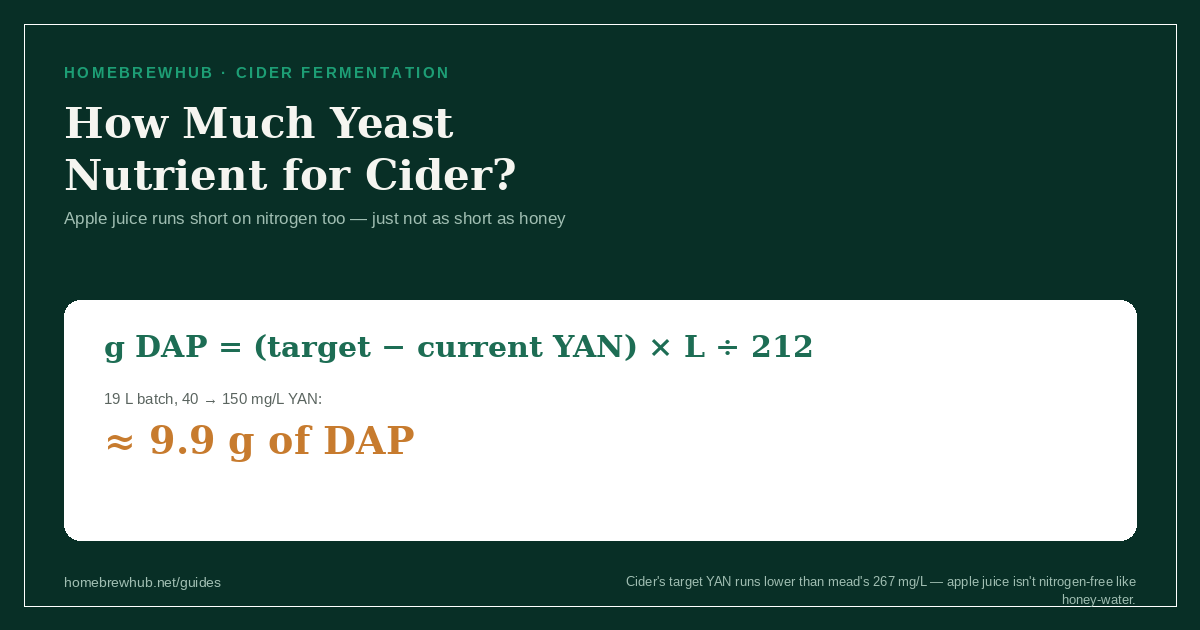
To calculate diammonium phosphate (DAP) dosage for cider: grams of DAP = (target YAN increase in mg/L × batch volume in liters) ÷ 212. For a 19 L batch with a starting YAN around 40 mg/L (typical for unfortified apple juice) aiming for a commonly-cited 150 mg/L target, that's (150 − 40) × 19 ÷ 212 ≈ 9.9 g of DAP.
Why apple juice runs short on nitrogen
Yeast Assimilable Nitrogen (YAN) — the ammonia and free amino acids yeast can actually use to build new cells and complete fermentation — comes from the fruit itself. Apple juice does carry some natural YAN, generally more than honey diluted with water, but usually well under what grape must typically provides. Left unsupplemented, a low-nitrogen must runs the risk of a sluggish or stuck fermentation, along with the sharp, rotten-egg smell of hydrogen sulfide from yeast cells fermenting under stress.
The DAP dosing formula
In solution, DAP contributes nitrogen at a rate that gives a workable conversion:
grams of DAP = (target YAN mg/L − current YAN mg/L) × batch volume in liters ÷ 212
Cider's target YAN is typically cited well below mead's — commonly in the neighborhood of 150 mg/L, compared to the 267 mg/L research-backed figure for mead. The gap comes down to raw material: honey-water starts from close to zero assimilable nitrogen, while apple juice starts with some already in place.
Worked example
For a 19 L (5 gal) batch starting around 40 mg/L YAN (a reasonable assumption without lab testing) and targeting 150 mg/L:
(150 − 40) × 19 ÷ 212 = 9.9 g of DAP
| Batch size | DAP needed (40→150 mg/L YAN) |
|---|---|
| 4 L (1 gal) | 2.1 g |
| 19 L (5 gal) | 9.9 g |
| 23 L (6 gal) | 11.9 g |
These are estimates, not a lab result
Actual YAN varies by apple variety, ripeness, and how the juice was pressed — 40 mg/L is a reasonable planning assumption for unfortified juice without a lab test, not a measured figure for your specific batch. If you have access to YAN testing, use your actual reading in place of the estimate. Without one, err on the side of the lower end of common targets rather than over-supplementing — excess nitrogen doesn't speed fermentation further and can affect the finished cider's character.
Splitting the dose
As with mead and wine, adding the full calculated DAP dose in one shot at pitch isn't ideal — the early-stage yeast population can't make full use of a large dose all at once. Splitting the total across the first few days of active fermentation, rather than dosing everything up front, keeps the yeast in healthier conditions throughout.
Skip the manual math
The Cider Calculator's Nutrient tool (Pro) applies this formula directly for your batch size and target.
For more on why apple juice is a challenging fermentation environment for yeast, see Home Cidermaking Science, Chapter 3.
YAN figures without lab testing are planning estimates. Handle DAP as directed on the product label, and avoid supplementing beyond your target — more nitrogen isn't automatically better for fermentation health or the finished cider.