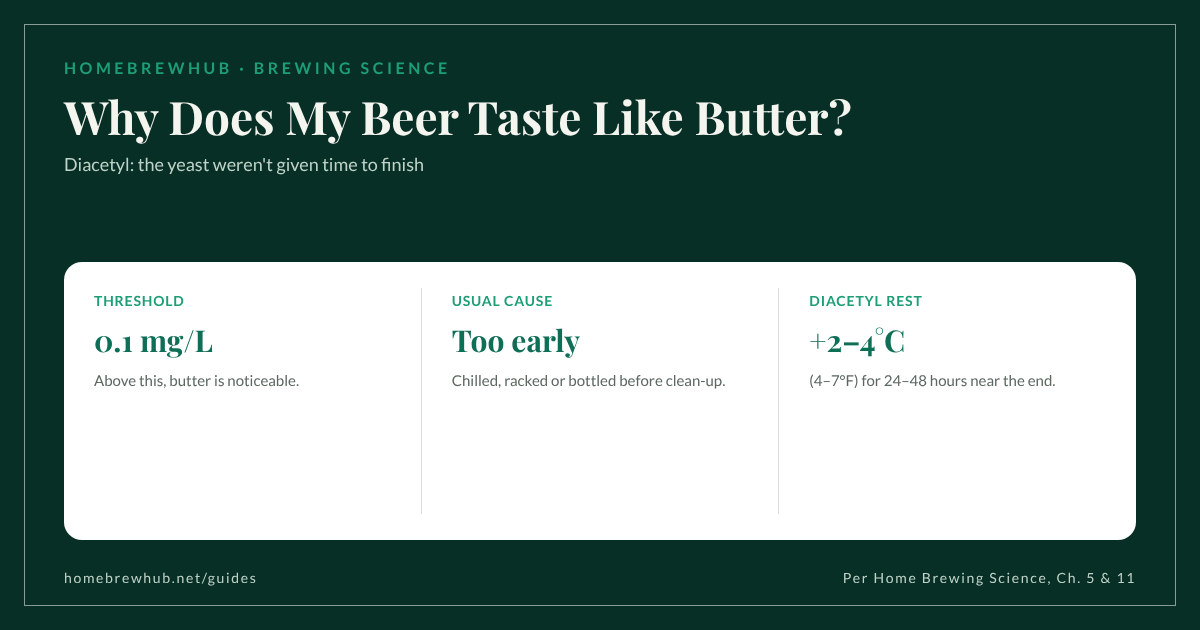
A buttery or butterscotch flavor is diacetyl. Yeast produce it at the peak of fermentation and normally clean it up themselves, converting it into flavorless compounds. That clean-up needs time on active yeast at a warm enough temperature. If the beer is chilled, racked off the yeast or bottled before it's done, the butter stays. That covers most cases. The exception is an infection, and that one waiting won't fix.
Where does diacetyl come from?
It's a by-product of the yeast's own amino acid synthesis, so every fermentation makes some. Yeast release precursors into the wort, and these turn into diacetyl outside the cell. The same yeast then take it back up and break it down: diacetyl to acetoin to 2,3-butanediol, which has no flavor. This happens at the end of primary fermentation and early in conditioning.
The sensory threshold is about 0.1 mg/L, and commercial lager brewers treat that number as the main sign a beer is ready. Home brewers can't measure it, but the rule of thumb in Home Brewing Science is simple: if you can clearly taste or smell butter, conditioning isn't finished, or something has infected the beer.
What makes diacetyl stay in the beer?
| Speeds up the clean-up | Slows it down |
|---|---|
| Enough warmth at the end of primary fermentation | Chilling quickly before conditioning is complete |
| Live, active yeast in contact with the beer | Racking off the yeast too early |
| Rousing the yeast back into the beer | Oxygen pickup toward the end of fermentation |
Two less obvious causes are also worth knowing. Wort low in amino nitrogen, which is common when a recipe leans heavily on sugar or unmalted adjuncts, makes the problem more likely. So does a slow, warm transfer of young beer that picks up oxygen on the way.
Diacetyl rest: one or two days before primary fermentation is expected to end, raise the temperature 2–4°C (4–7°F) above the normal range and hold it for 24–48 hours. Then cool gradually to conditioning temperature.
How do you do a diacetyl rest?
The yeast must still be active, so the warm-up goes in just before fermentation finishes, not after the beer has already gone cold and still. Hold the warmer temperature for one to two days, then bring it down gradually. For reference, most ale strains work at a steady 18–22°C (64–72°F) through primary fermentation, and the rest sits 2–4°C (4–7°F) above whatever range your strain uses.
After visible fermentation stops, give the yeast another 2–3 days before racking. If you're unsure whether the beer is ready, an extra week is a cheaper mistake than bottling too early.
When is butter a sign of infection?
Lactic acid bacteria such as Lactobacillus and Pediococcus also produce diacetyl, and yeast won't clean up what the bacteria keep making. If the buttery note doesn't fade with more time on the yeast, suspect an infection rather than impatience. The usual sources at home are poorly rinsed hoses and scratched plastic buckets, where bacteria hide from sanitizer.
A trace of diacetyl isn't always a fault, though. Some ales keep a hint of it on purpose, where it reads as a smooth richness rather than butter.
Underpitched yeast make the clean-up harder. See How Big Should Your Yeast Starter Be? or plan the batch in the Beer calculator.
The whole off-flavor catalog
Home Brewing Science covers diacetyl in Chapter 5 (yeast) and Chapter 11 (troubleshooting), alongside acetaldehyde, DMS, phenols, oxidation and infection.
Educational content. Rules on home fermentation vary by country; check the law where you live. Full disclaimer