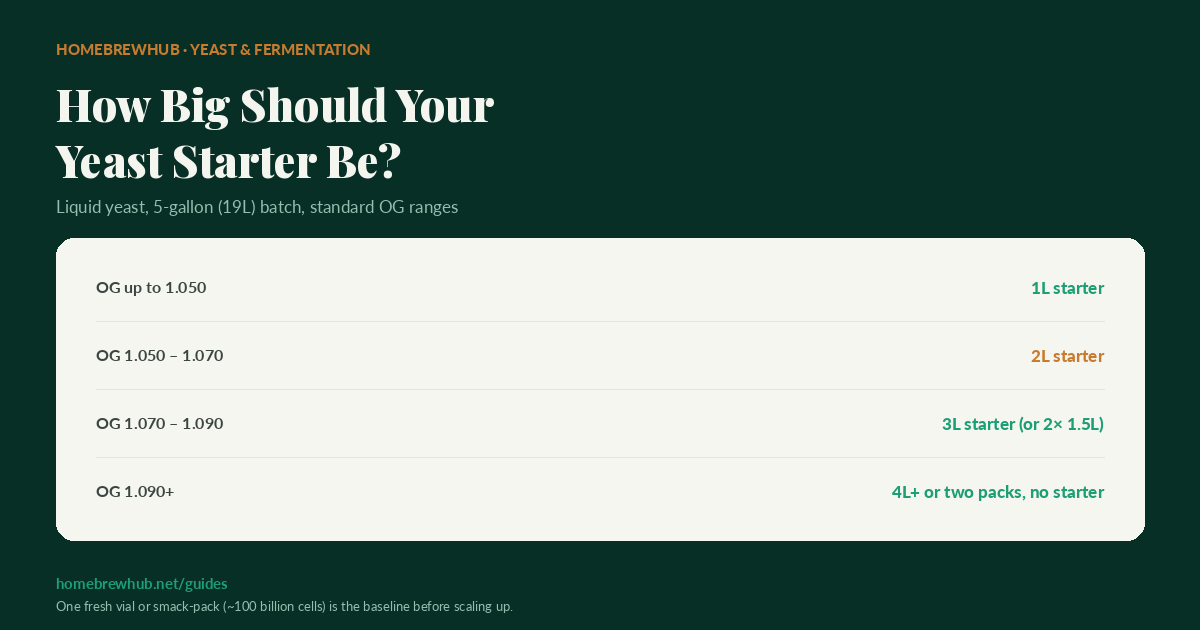
For a 5-gallon (19L) batch using liquid yeast, a rough starter-size guide by target OG: about 1L for OG up to 1.050, 2L for OG 1.050-1.070, 3L for OG 1.070-1.090, and 4L or more (or splitting the pitch across two packs) above 1.090. Dry yeast usually skips this step entirely — a single packet typically has far more viable cells than a fresh liquid vial.
Underpitching — starting with too few healthy yeast cells for the amount of sugar in your wort — is one of the most common causes of off-flavors and sluggish fermentations in homebrewing, and it's also one of the easiest to avoid once you know roughly how much yeast a given batch actually needs.
Why one vial usually isn't enough
A fresh liquid yeast vial or smack-pack typically contains around 100 billion cells — a reasonable amount for fermenting a beer, but not necessarily enough on its own for a standard-strength 5-gallon batch, and increasingly short of what's needed as gravity climbs. A starter grows that initial population into a larger, healthier one before brew day, so the yeast can get to work immediately instead of struggling to multiply inside an already-fermenting wort.
Yeast health matters as much as yeast count. A starter doesn't just add more cells — it gives the existing population a chance to build up glycogen reserves and finish any lag phase before it's asked to ferment a full batch, which is part of why starters tend to produce cleaner fermentations even when cell count alone might look adequate.
How does batch size change the starter size?
The table above assumes a 5-gallon (19L) batch. Starter size scales with total fermentable sugar, which depends on both OG and volume together — not OG alone:
- Bigger batch, same OG. A 10-gallon batch at the same gravity roughly doubles the total sugar, so it needs proportionally more yeast — scale the starter size up accordingly, or step up to a larger single starter rather than assuming the same size still covers it.
- Smaller batch, same OG. A 1-gallon batch needs only a fraction of the yeast a 5-gallon batch does at the same gravity — using a full-size starter here is usually unnecessary and can actually overpitch the batch.
Yeast strain matters too — some strains are naturally more vigorous and reproduce faster than others, so a strain known for sluggish starts may benefit from sizing slightly up from the table above, especially at the higher end of the gravity ranges.
Dedicated yeast starter calculator — coming soon
A calculator that sizes your starter exactly to your batch volume, target OG, and yeast strain is on the way as part of Pro. In the meantime, the recipe calculator shows your batch's OG so you can match it against the table above.
A simple way to think about it
You're not just trying to add "some yeast" — you're trying to match the size of the yeast population to the amount of sugar it's about to ferment. Get the OG and batch size right, and the starter size mostly takes care of itself from there.
For the full picture on yeast health, pitching rates, and fermentation temperature control, see the fermentation chapter in Home Brewing Guide.
Figures above are general reference ranges for standard ale strains and typical homebrewing conditions — actual yeast health, strain vigor, and wort composition all affect the ideal starter size. When in doubt, sizing slightly larger is safer than underpitching.