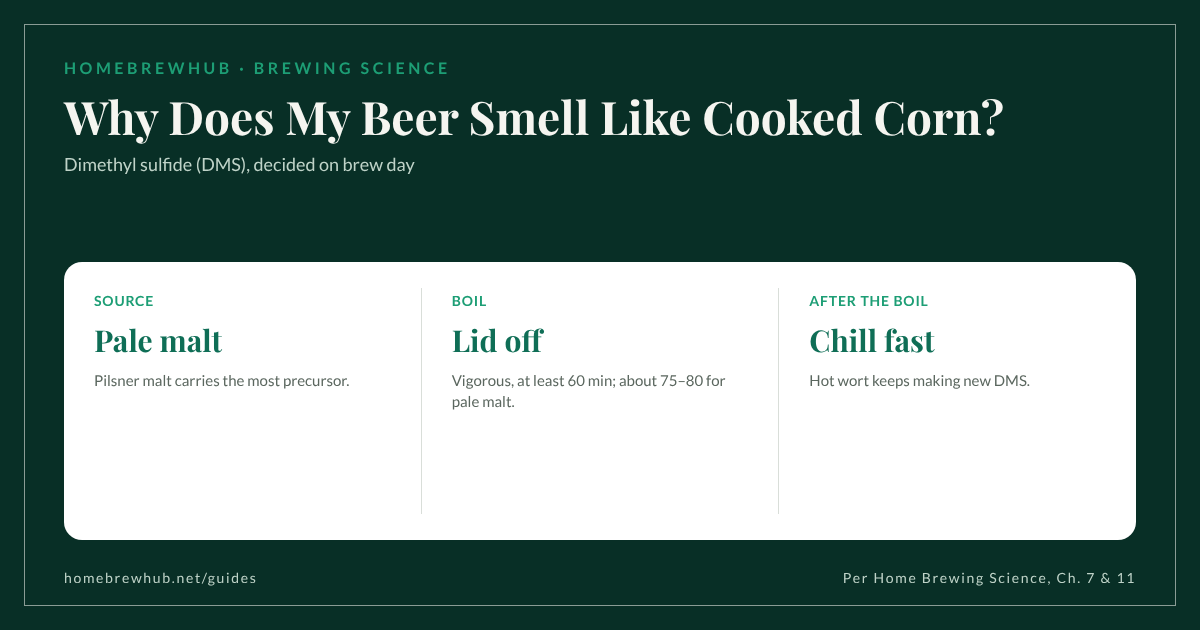
That smell is dimethyl sulfide (DMS). Its precursor, S-methylmethionine (SMM), forms in the malt during malting and breaks down into DMS when the wort is heated. DMS is volatile, so a vigorous, uncovered boil drives it off. A boil that's too gentle, too short or covered with a lid leaves it in, and wort that cools slowly keeps making more of it after the boil is over.
Why do some beers have more DMS than others?
Because the precursor comes from the malt, and some malts carry much more of it. Pale pilsner-type malt has more DMS precursor than heavily kilned malts, so recipes built on it need the most care on brew day.
How long and how hard should you boil?
Home Brewing Science gives two reference points. The troubleshooting chapter sets at least 60 minutes as the practical minimum for malts high in DMS precursors. The boiling chapter notes that DMS is almost entirely driven off during a sufficiently long, vigorous boil, with a rough benchmark of 75–80 minutes at close to 100°C (212°F).
| Brew-day step | What to do | Why |
|---|---|---|
| Boil strength | A real rolling boil, not a simmer | DMS has to be carried off with the steam |
| Lid | Off for the whole boil | DMS needs an open kettle to escape |
| Boil length | At least 60 minutes; about 75–80 for pale malt | The precursor needs time to convert and boil off |
| Chilling | Start right away, with a chiller | Hot wort keeps making new DMS |
DMS formation doesn't stop when the flame goes off. The precursor keeps converting as long as the wort stays hot, so a slow cool-down can rebuild the DMS the boil just removed.
Why does cooling speed matter so much?
The hotter the wort stays and the longer it stays hot, the more DMS forms after the boil. That's why the pause before chilling should be as short as practical. If you whirlpool, a rest of 15–20 minutes is enough for the hops and protein to settle into a cone. Then start the chiller rather than letting the pot cool on its own.
What if it's already in the beer?
All the fixes Home Brewing Science gives happen on brew day: a strong, uncovered boil of the right length and fast chilling. So the practical step is to note the batch and change the process next time, especially if the recipe uses a lot of pale pilsner malt.
Boil length also changes your bitterness. See How Boil Time Affects Hop Utilization, or plan the batch in the Beer calculator.
From malt to boil to off-flavors
Home Brewing Science covers DMS in Chapter 7 (the boil), Chapter 5 (yeast and flavor) and Chapter 11 (troubleshooting).
Educational content. Rules on home fermentation vary by country; check the law where you live. Full disclaimer