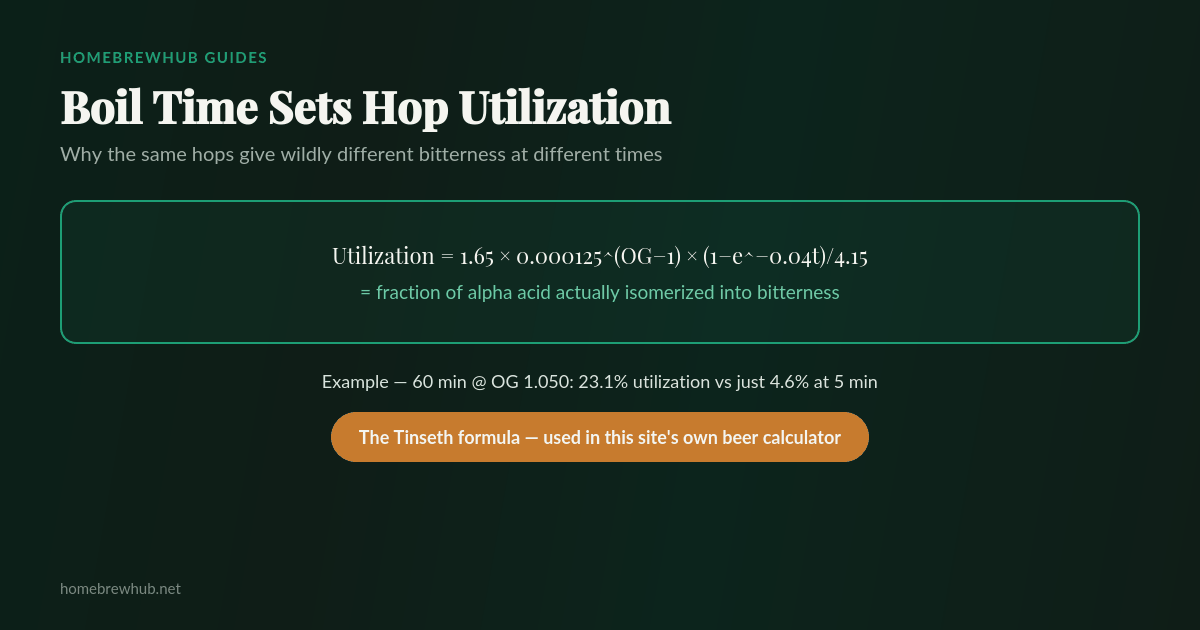
Hop utilization — the fraction of alpha acid actually isomerized into bitterness — depends on both boil time and wort gravity, following the Tinseth formula: utilization = 1.65 × 0.000125^(OG−1) × (1−e^(−0.04×time))/4.15. At a typical OG of 1.050, a 60-minute boil reaches 23.1% utilization, while a 5-minute addition reaches only 4.6% — roughly 5 times less from the identical hops.
What's actually happening during the boil
Alpha acids in hops aren't bitter on their own — they need to isomerize (change chemical structure) through heat and time to become soluble, bitter-tasting compounds. That isomerization process is never complete: even a full 60-minute boil typically converts only 20-30% of available alpha acid into usable bitterness. The rest never isomerizes, regardless of how long you boil.
The Tinseth formula, piece by piece
The formula has two multiplying factors:
Bigness factor = 1.65 × 0.000125^(OG−1) — accounts for wort gravity. Denser, more viscous high-gravity worts physically reduce how effectively alpha acids isomerize and dissolve, so this factor shrinks as OG rises.
Boil time factor = (1 − e^(−0.04×t)) / 4.15 — accounts for time. Utilization rises quickly at first, then levels off — the curve is steep in the first 15-20 minutes and flattens out considerably by 60 minutes.
This exact formula is what runs behind the scenes in HomeBrewHub's own beer calculator every time it computes IBU from your grain bill and hop schedule — not a simplified approximation, the real Tinseth math.
Utilization by boil time (at OG 1.050)
| Boil Time | Utilization |
|---|---|
| 60 min | 23.1% |
| 30 min | 18.6% |
| 15 min | 11.9% |
| 10 min | 8.4% |
| 5 min | 4.6% |
| 0 min (flameout) | ~0% |
Why late additions still matter, even at near-zero utilization
A flameout or whirlpool addition contributes essentially no measurable bitterness by this formula — but that's not why brewers use them. Late and dry-hop additions are about aroma and flavor compounds, which volatilize and boil off quickly, rather than bitterness, which needs sustained heat and time to develop at all.
Dry hop additions (added after fermentation, with no boiling at all) contribute zero IBU under this formula — there's no heat to drive isomerization. Any bitterness perception from a heavily dry-hopped beer comes from other sources, not the dry hop charge itself.
Skip the manual math
The beer calculator applies the full Tinseth formula automatically across your entire hop schedule, giving you a real IBU total as you build the recipe.
For the full picture on hop chemistry, boil timing strategy, and late-hop aroma extraction, see Home Brewing Science, Chapter 07.
The Tinseth formula is an estimate based on average conditions — actual utilization varies with kettle geometry, boil vigor, hop pellet form, and other factors. Treat calculated IBU as a reliable planning target, not a lab-measured guarantee.