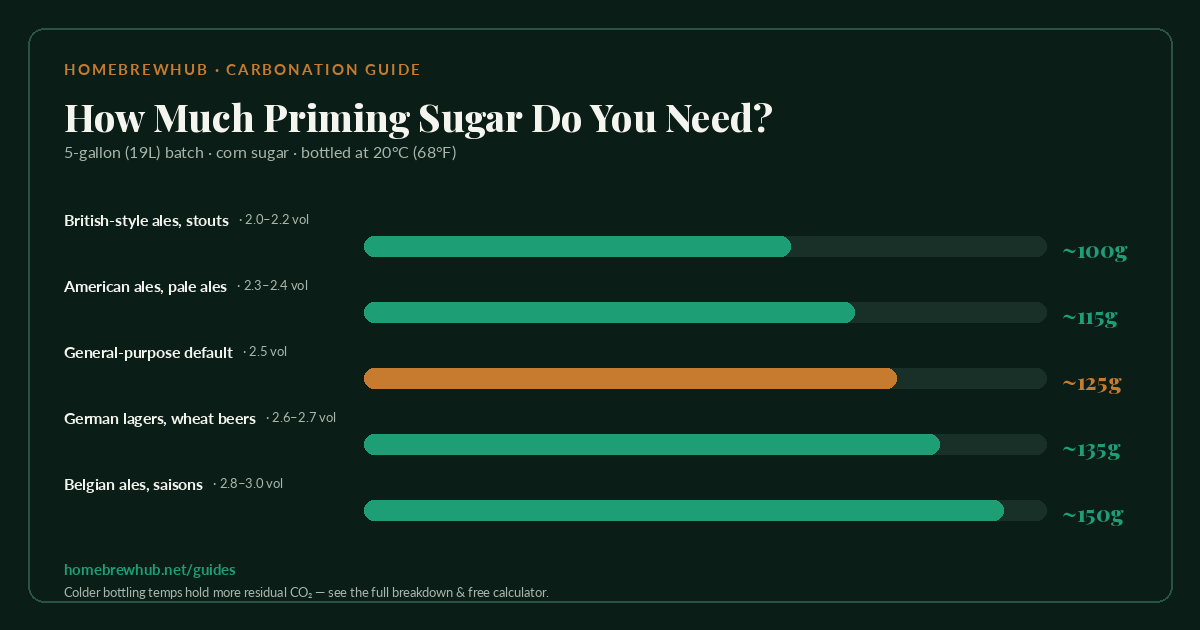
For a 5-gallon (19L) batch of beer bottled at 20°C (68°F), most styles need 100-150g of corn sugar (dextrose) to carbonate properly: about 100g for British-style ales, 125g as a general-purpose default, and up to 150g for Belgian ales and saisons. The exact amount depends on your target carbonation level for the style and how cold the beer was when it finished fermenting.
Priming sugar gives bottle-conditioning yeast one last job: eat a measured amount of sugar and produce just enough CO₂ to carbonate the beer inside a sealed bottle. Too little, and you get flat beer. Too much, and you're looking at gushers — or, in rare but real cases, bottles that fail under pressure.
The good news is that the amount isn't a guess. It comes down to two numbers: how much CO₂ your beer already holds from fermentation (based on temperature), and how much more you want it to hold (based on style). The gap between those two is what your priming sugar needs to supply.
Reference table: 19L (5 gal) batch, corn sugar
These figures assume a batch that finished fermenting and is being bottled at around 20°C (68°F) — the most common home-brewing scenario. If your beer conditioned cooler or warmer, see the note below the table.
| Style example | Target CO₂ (volumes) | Corn sugar |
|---|---|---|
| British-style ales, stouts | 2.0 – 2.2 | ~100g (3.6 oz) |
| American ales, pale ales | 2.3 – 2.4 | ~115g (4.1 oz) |
| General-purpose default | 2.5 | ~125g (4.4 oz) |
| German lagers, wheat beers | 2.6 – 2.7 | ~135g (4.7 oz) |
| Belgian ales, saisons | 2.8 – 3.0 | ~150g (5.3 oz) |
Beer that's already cold or spent time fermenting cool holds more residual CO₂ than beer that fermented warm — so it needs less priming sugar to hit the same target. A batch bottled at 16°C needs meaningfully less sugar than the same batch bottled at 24°C for the same carbonation level.
How do batch size and bottling temperature change the amount?
The 19L/20°C numbers above are a solid starting point, but two things will shift the real number for your batch:
- Batch size. A 1-gallon (3.8L) batch needs roughly a fifth of the sugar a 5-gallon batch does — priming sugar scales directly with volume, not with style.
- Bottling temperature. This is the one people miss. Beer holds dissolved CO₂ from fermentation itself, and colder beer holds more of it. If you don't account for that residual CO₂, you'll oversweeten your priming and end up over-carbonated even if your "volumes" math looked right on paper.
Sugar type matters too — corn sugar (dextrose), table sugar (sucrose), and dry malt extract (DME) don't produce identical amounts of CO₂ per gram, because part of what you're adding isn't fermentable, or ferments slightly differently. Table sugar needs a bit less than corn sugar by weight; DME needs more.
Skip the math — use the calculator
Enter your batch size, bottling temperature, target style, and sugar type. It handles the residual CO₂ correction and sugar-type conversion for you.
A simple way to think about it
You're not just adding "enough sugar for 5 gallons" — you're adding enough to close the gap between where your beer already is (residual CO₂ from fermentation temperature) and where you want it to end up (target carbonation for the style). Get the batch size, the bottling temperature, and the style target right, and the sugar amount takes care of itself.
For the full mechanics of bottle conditioning — including how long to wait, warm-conditioning windows, and troubleshooting under- or over-carbonated bottles — see the carbonation chapter in Home Brewing Guide.
Figures above are calculated using the standard residual-CO₂ formula for priming sugar, referenced against published home-brewing carbonation tables. Always weigh priming sugar rather than measuring by volume, and never exceed style-appropriate carbonation targets — significantly over-priming a batch can cause bottles to over-pressurize.