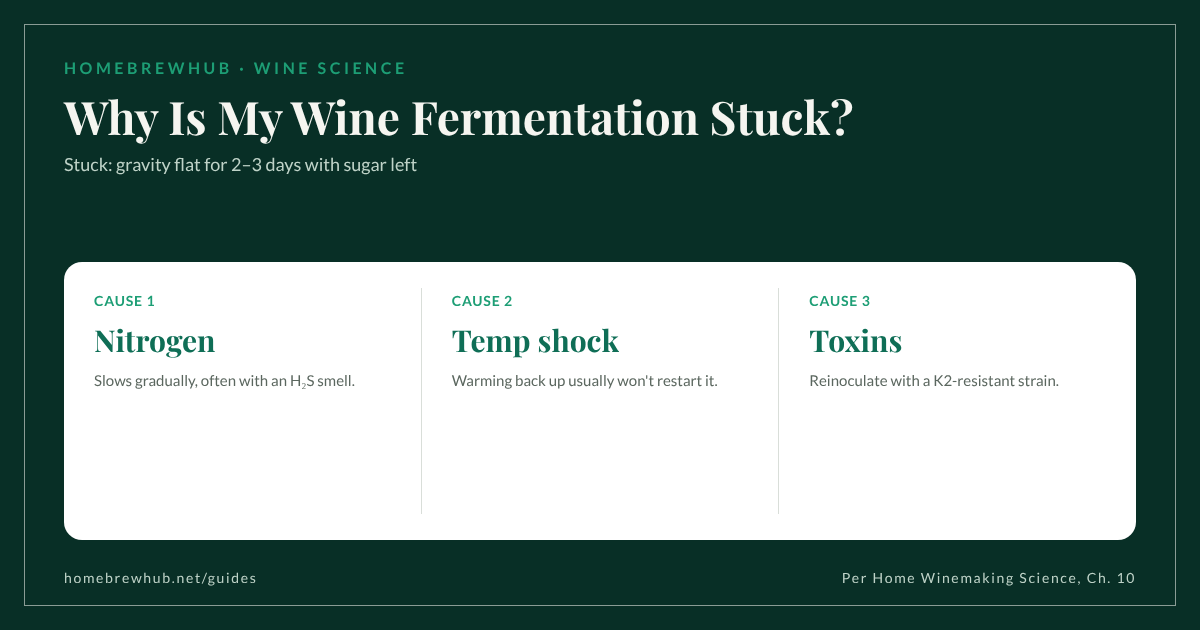
First decide whether it's stuck or just slow. If repeated gravity readings are still dropping, even slowly, the fermentation is sluggish and still active. If gravity holds steady for two or three days in a row while sugar is clearly still there (above the calculated final gravity), it has stuck. The three usual causes are nitrogen deficiency, temperature shock and toxins, and each needs a different response.
Sluggish or stuck: why the difference matters
A sluggish fermentation is still running, and intervention can genuinely help. In a stuck one, part of the yeast population has already lost viability, so simple measures usually don't work and something more drastic is needed. Judge it by numbers, not by the airlock or the feeling that "the yeast still seem to be working". Even in labs, different methods of measuring yeast viability can give different results for the same culture.
| Cause | Tell-tale sign | What to do |
|---|---|---|
| Nitrogen deficiency | Slows down gradually, often with a sulfur (H₂S) smell well before it stops | If it's only sluggish, moderate nitrogen supplementation often restores normal speed |
| Temperature shock | Stopped after a sudden cold snap or an overheated vessel | Returning to normal temperature usually isn't enough; reinoculate |
| Toxins | A first reinoculation shows no result within a few days | Reinoculate with a killer-toxin resistant (K2-resistant) strain |
Summarized from Home Winemaking Science, Chapter 10.
Cause one: nitrogen deficiency
This is the most common cause. Yeast need assimilable nitrogen (YAN), and when the must doesn't have enough, the slowdown begins gradually, often with a rotten-egg (H₂S) smell well before fermentation stops. Caught while the fermentation is still sluggish rather than stuck, moderate nitrogen supplementation often brings it back to normal speed.
Cause two: temperature shock
A sudden cold snap or an overheated vessel damages yeast cells. Part of the damage comes through the cell membrane, especially once ethanol has built up in the must. If the fermentation has already stopped this way, simply bringing the temperature back to normal usually won't restart it on its own. The damaged cells don't recover, so a fresh culture is needed.
If a first reinoculation produces nothing within a few days, the problem is probably not a missing nutrient but something toxic to yeast. Adding more of the same strain is likely to fail again.
Cause three: toxins
Some stuck fermentations come from substances on the grapes that are directly toxic to yeast: pesticide residues, mold byproducts (mycotoxins), or a killer toxin, a protein some wild Saccharomyces strains release against other, sensitive strains. The same toxin acts on any new culture you add. That's why Home Winemaking Science recommends reinoculating with a strain the manufacturer sells as killer-toxin resistant (killer-resistant or K2-resistant) rather than simply adding more of the same yeast.
Prevention starts with nitrogen: How Much Yeast Nutrient (DAP) to Add. Track gravity and plan the batch in the Wine calculator.
From grape to glass, and what goes wrong
Home Winemaking Science covers yeast nitrogen in Chapter 3 and troubleshooting fermentation problems in Chapter 10.
Educational content. Rules on home fermentation vary by country; check the law where you live. Full disclaimer