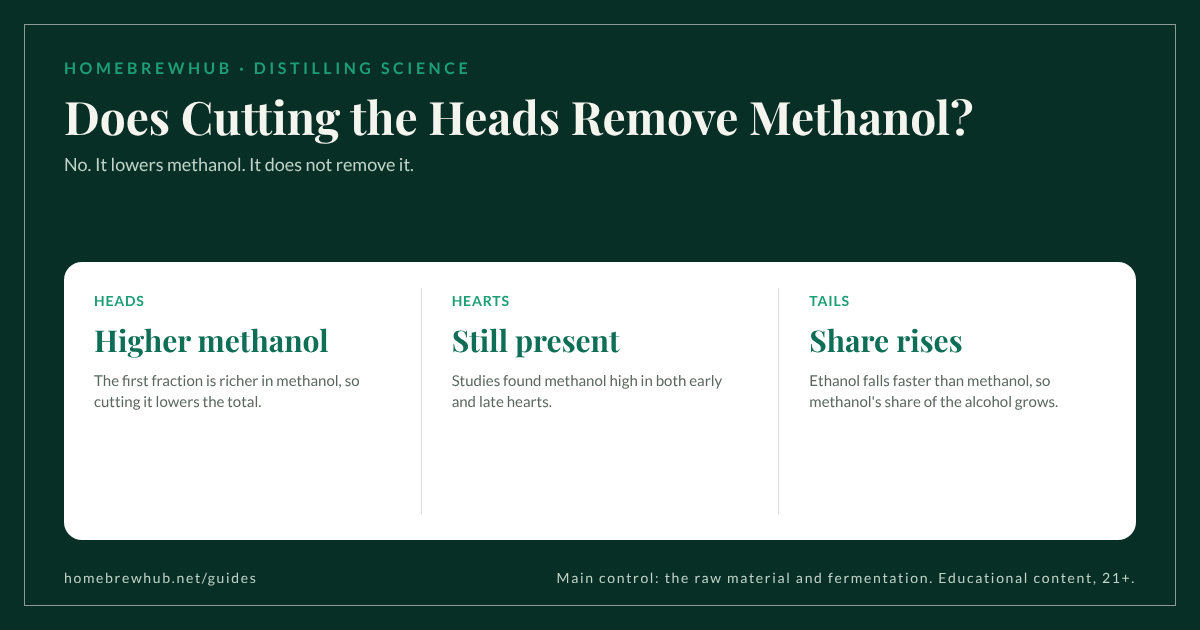
No. Cutting the heads lowers methanol, but it does not remove it. Studies cited in distilling handbooks found methanol in every part of the run: high in both the early and the late hearts, and in one fruit spirit most concentrated in the tails. How much methanol a spirit holds depends above all on the raw material and the fermentation, not on the cut.
Why doesn't all the methanol come off first?
Methanol boils at 64.7°C (148.5°F), below ethanol, so it seems logical that it should leave the still first. But an alcohol and water mixture doesn't behave like an ideal mixture. Alcohol and water molecules link through hydrogen bonds, and methanol in that solution doesn't follow its own boiling point.
The measurements show it. In the Claus and Berglund study cited by Buglass, methanol was high in both the early and the late hearts, with a significant amount in the middle. In the distillation of a melon spirit (Hernández-Gómez), methanol was present in every fraction, and its highest concentration turned up in the tails.
Why does methanol's share rise toward the end of the run?
Botelho and co-authors, summarizing many studies, write that the first fraction is indeed richer in methanol, but methanol stays in the distillate throughout the run and its level drops only slightly. Ethanol falls much more sharply toward the end. So relative to pure alcohol, the share of methanol rises toward the tails. That is why both cuts matter: the heads and the switch to tails.
Methanol can't be "cut off" with the heads. It runs through the whole distillation, and relative to pure alcohol its share rises toward the end of the run. Cutting the heads is necessary but not sufficient.
Is a fixed amount of heads per gallon enough?
No. Hobby books often repeat a rule of thumb: discard a small fixed amount of heads for every gallon of mash, as if all the methanol collects in it. Miller calls that advice lazy at best and dangerous at worst, and acknowledges there is no way to remove methanol completely: small amounts will always be present in the heads, the hearts and the tails.
Where does methanol in a spirit come from?
Methanol isn't a yeast product in the usual sense. It forms from pectin, through pectin methylesterase enzymes that are present in the raw material itself. That is why nearly every spirit contains some methanol, and why the amount depends above all on what the wash is made from and how. According to Botelho, methanol is highest where fermentation happens in contact with skins and solids, such as grappa and other pomace spirits. Grain holds little pectin, so a grain wash is safer in this respect, though not methanol-free.
| Factor | Effect on methanol |
|---|---|
| Pectolytic enzymes added to mash or juice | Increase it (trials with apples, Bartlett pears, grapes) |
| Fermenting with pomace, skins, pulp | Increases it (apple pomace spirit had significantly more than spirit from juice) |
| Very ripe fruit | Increases it |
| Fruit variety | Matters (apple, pear, plum, currant, grape) |
| Pasteurizing juice before fermentation | Reduces it significantly (apple juice trials) |
| Heating must without skins | Reduces it |
Source: Botelho and co-authors, review of methanol in fruit spirits, as summarized in Home Distilling Science, Chapter 11.
Can you tell how much methanol a spirit contains?
Not at home. According to the PAHO/WHO alert of October 7, 2025, methanol is very difficult to tell apart from ethanol by smell or taste, and a hydrometer doesn't show it either. Even legal producers control methanol rather than reach zero: EU limits for fruit spirits run from 1,000 to 1,350 g per 100 L of pure alcohol depending on the fruit (per Miller). Only laboratory analysis tells you where a spirit stands.
What are the signs of methanol poisoning?
According to PAHO/WHO, symptoms appear 2–48 hours after drinking, or within minutes after large doses: first nausea, vomiting, headache and dizziness, then blurred vision, flashes of light and blind spots, and in severe cases confusion, seizures and organ failure. Because of the delay, a person may feel ordinarily drunk until the next day. If methanol poisoning is suspected, get emergency medical help right away, without waiting for vision problems.
The full chemistry of methanol and cuts
Home Distilling Science covers why methanol behaves this way during distillation (Chapters 5 and 7), and where it comes from, how dangerous it is and how to reduce it before the still is lit (Chapter 11).
Every wash profile in the Spirits catalog lists its raw material with a source, and the pomace profile carries a separate methanol note. See also Home Distilling Science, Chapter 11: Safety: Methanol, Fire, and the Law.
Educational content about the science of distillation. Distilling spirits at home without a license is illegal in many countries, including the United States. Check the law where you live. This guide does not give still settings or cut points. Full disclaimer