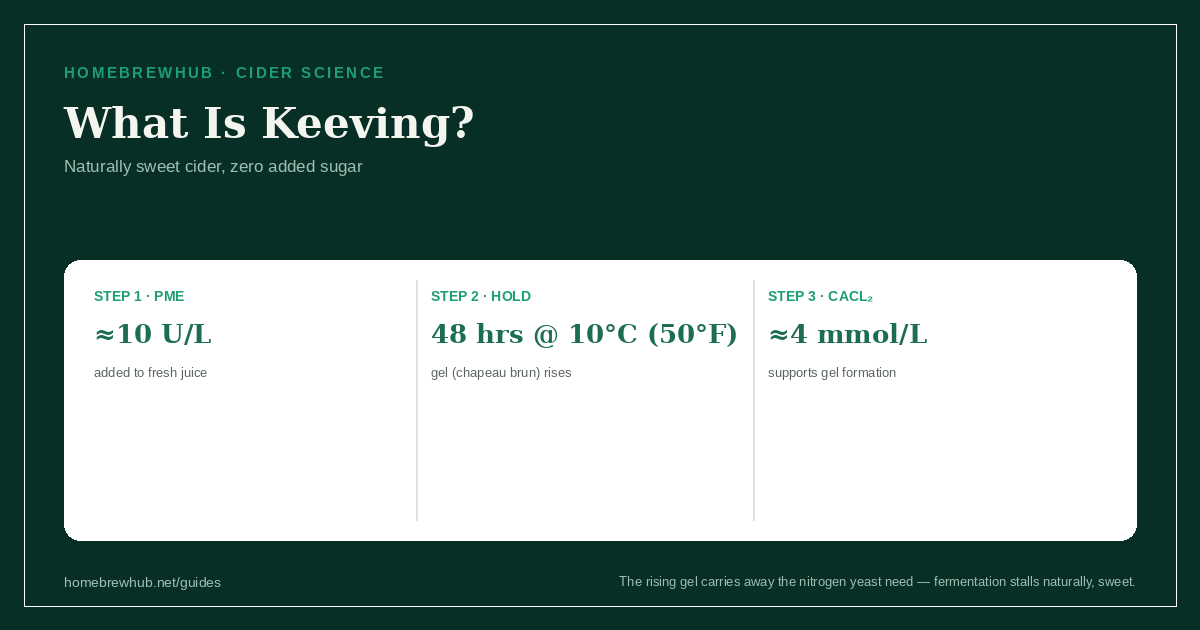
Keeving is a traditional French technique that produces naturally sweet cider without adding any sugar back after fermentation. It works by forming a gel in the fresh juice that rises to the top and physically carries away the nutrients yeast need to keep fermenting — so fermentation slows down and stalls out on its own, part-way through, leaving real unfermented sugar behind.
How the gel forms
The key enzyme is pectin methylesterase (PME), which occurs naturally in apples but is usually added in a purified, more reliable form. PME reacts with the pectin already present in apple juice, and in the presence of calcium, the reaction produces a gel structure. Over roughly 48 hours at a cool, controlled temperature, this gel — known as the chapeau brun ("brown hat") — rises to the surface, carrying suspended solids, nutrients, and some of the juice's nitrogen along with it.
Once the cap has fully risen and a layer of clear juice has separated out beneath it, that clear juice is racked away from both the cap above and the sediment below — leaving a must that's naturally depleted of the nutrients yeast rely on.
The basic protocol: PME at roughly 10 U/L, held at 10°C (50°F) for about 48 hours to let the cap form and rise, with calcium chloride added at roughly 4 mmol/L to support gel formation. Temperature control matters — the reaction needs to proceed slowly enough for a well-formed, easily separable cap.
Why depleted nutrients mean natural sweetness
Yeast need assimilable nitrogen and other nutrients to build new cells and keep a fermentation going at a healthy pace. A must that's had a substantial share of those nutrients skimmed off by the rising cap gives the yeast population less to work with from the very start. Instead of powering through to a fully dry finish, the colony runs low on what it needs partway through and fermentation slows dramatically, then stalls — at a gravity well above 1.000, with real residual sugar intact.
This is a fundamentally different mechanism from stopping fermentation with sulfite, cold-crashing, or filtering out the yeast after the fact. Those methods interrupt a fermentation that would otherwise finish dry. Keeving changes the must itself before fermentation starts, so it never has the fuel to get there.
Why keeving is temperamental
Keeving has a reputation among cidermakers as inconsistent, and that reputation is earned. The gel-forming reaction is sensitive to the juice's natural pectin and calcium content — which varies by apple variety, harvest, and pressing method — as well as to temperature control during the 48-hour hold. Too warm, and the cap forms too fast and doesn't separate cleanly. Too little natural calcium in the juice, and the reaction may not proceed fully even with CaCl2 added. Traditional cidermakers often blend specific keeving apple varieties partly because their juice chemistry keeves more reliably.
| Step | What happens |
|---|---|
| Add PME (~10 U/L) to fresh juice | Enzyme begins reacting with natural pectin |
| Add CaCl2 (~4 mmol/L) | Calcium supports gel formation |
| Hold ~48 hours at 10°C (50°F) | Gel (chapeau brun) forms and rises, carrying nutrients with it |
| Rack clear juice from beneath the cap | Nutrient-depleted must moves on to fermentation |
See the full keeving chapter
Home Cidermaking Science covers the chemistry in depth — including why some batches keeve cleanly and others don't, and how to troubleshoot a keeve that isn't separating.
For the full keeving protocol, troubleshooting, and the pectin/calcium chemistry behind it, see Home Cidermaking Science, Chapter 8.
Keeving is a more advanced, less predictable technique than back-sweetening with sulfite and sorbate — expect some batches not to separate cleanly, especially on a first attempt with unfamiliar juice.