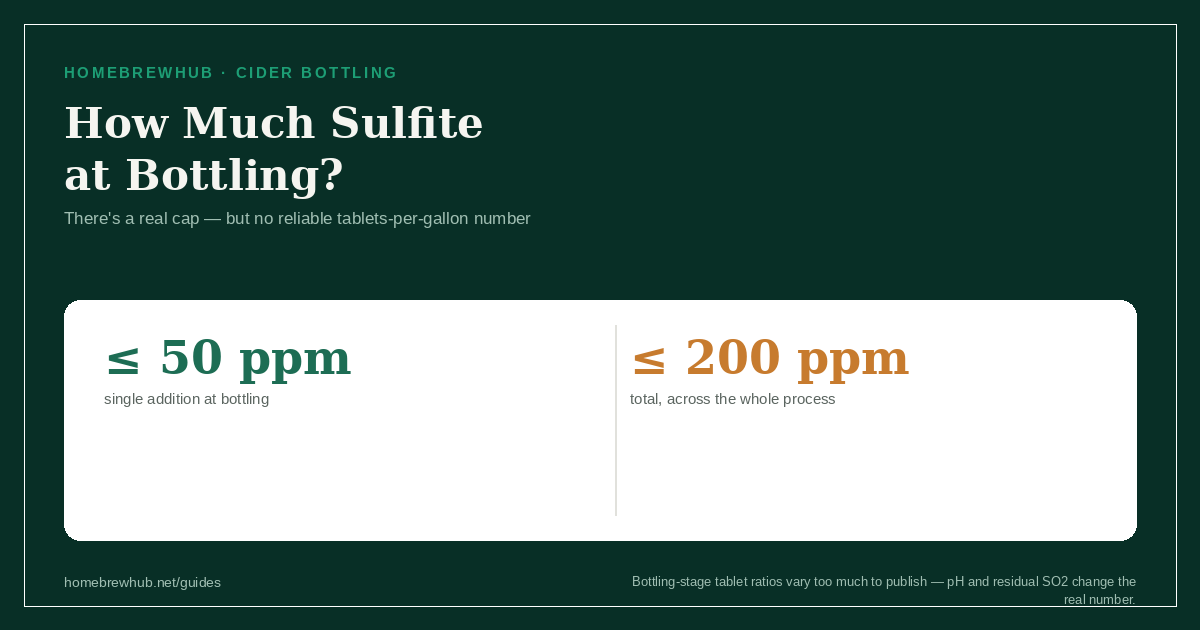
At bottling, keep any single sulfite addition to cider at or below 50 ppm free SO2. Across the entire production process — juice treatment plus bottling plus any other addition along the way — total sulfite should stay at or below 200 ppm. Those two numbers are the actual caps; there's no equally reliable "X tablets per gallon" figure to go with them, and that's worth explaining rather than papering over.
Why there's no simple tablets-per-volume number
Campden tablets (potassium or sodium metabisulfite compressed into a standard dose) are commonly cited as delivering somewhere around 50-75 ppm of SO2 per gallon, depending on brand, tablet size, and who's doing the citing. That range alone should be a signal: it's a rule of thumb, not a controlled figure. Two more variables make a single bottling-stage number even less reliable:
- pH. Sulfite's effectiveness against spoilage microbes depends heavily on pH — a more acidic cider needs less free SO2 to get the same protection than a higher-pH one.
- Sulfite already present. If you sulfited the juice before fermentation, some of that dose has already been consumed by must components and by the yeast itself. What's left by bottling time isn't the same as what you added weeks earlier.
Combine a wrong assumption on any of those with a tablet-potency range that's already ±50%, and a flat "1 tablet per gallon" instruction can land you well outside the 50/200 ppm caps in either direction — under-protected, or over the limit.
The 50 ppm single-addition / 200 ppm total caps aren't a suggestion — they're the ceiling before off-flavors and excessive SO2 aroma become a real risk, independent of any specific product's dosing instructions.
What to use instead of a flat ratio
Because the real dose depends on your batch volume, current free SO2 level, and target ppm, the reliable way to get an exact number is a calculator that takes those inputs — not a rule of thumb that assumes them away. The free/Pro Cider Calculator's Sulfite Dosing tool does exactly that: enter your batch size and target ppm, and it works out the addition for your actual numbers rather than a generic gallon.
Sulfite and back-sweetening
If you're back-sweetening a still cider, sulfite alone won't stop the added sugar from restarting fermentation — pair it with potassium sorbate, which blocks yeast reproduction. Sulfite handles spoilage microbes and oxidation; sorbate handles the yeast that's already there. Skipping either one is a common cause of bottle bombs in home-sweetened cider.
Sulfite and bottle-conditioned sparkling cider
If you're priming with sugar for natural carbonation, skip sulfite at that stage, or keep it minimal — you need live, healthy yeast to carbonate the bottle, and sulfite works against exactly that.
| Stage | Sulfite guidance |
|---|---|
| Juice treatment | Standard dose, well under the 200 ppm lifetime total |
| Bottling — still, back-sweetened | ≤50 ppm this addition, paired with potassium sorbate |
| Bottling — sparkling, bottle-conditioned | Skip or minimize — live yeast needed to carbonate |
| Running total, any point | ≤200 ppm |
Get your exact dose
The Cider Calculator's Sulfite Dosing tool scales the addition to your batch volume and current SO2 level, instead of a flat tablet ratio.
For the full stabilization protocol — sulfite, sorbate, and the order they need to go in — see Home Cidermaking Science, Chapter 10.
Follow the safety guidance on your sulfite product's label. This article covers dosing math, not a substitute for that label or for testing your own cider's actual free SO2 level.