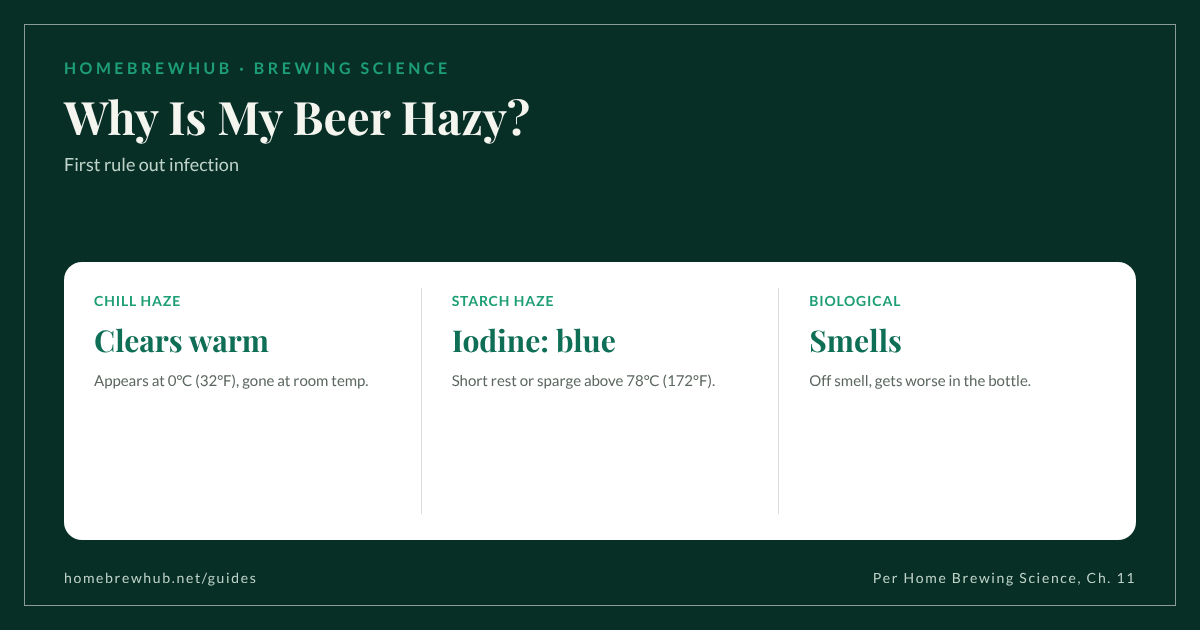
First rule out infection. Haze that comes with an off smell or taste and keeps getting worse in the bottle week after week is biological: wild yeast or bacteria. Haze without a smell is colloidal, caused by substances already in the beer. The most common colloidal types are chill haze, which disappears when the beer warms up, starch haze from an incomplete mash, and protein haze from a weak cold break.
This is about beer that was supposed to be clear. Haze is normal for many styles, including wheat beer, NEIPA and unfiltered ales.
Which type of haze is it?
| Type | How to tell | Usual cause |
|---|---|---|
| Biological | Off smell or taste, gets worse in the bottle | Wild yeast or bacteria |
| Chill haze | Appears at 0°C (32°F), clears at room temperature | Polypeptide and polyphenol complexes; heavy hopping or long hot grain contact |
| Permanent haze | Like chill haze, but doesn't clear when warm | Chill haze left untreated until the complexes grew too large |
| Starch haze | Iodine test turns blue | Short saccharification rest, or sparge water above 78°C (172°F) |
| Protein haze | No smell; drops out with temperature or acidity swings | Weak cold break, or a boil without good protein coagulation |
Summarized from Home Brewing Science, Chapter 11.
Chill haze: the most common case
Chill haze appears when the beer is chilled to 0°C (32°F) and disappears when it warms back to room temperature. It comes from complexes of polypeptides and polyphenols, and it's a classic problem in heavily hopped beer or beer whose wort spent a long time in contact with the grain bed at high temperature. Filtration doesn't remove it. You need an adsorbent (PVPP for polyphenols, silica gel for protein), or you accept it if the beer is served cold. Left untreated for too long, the complexes can grow into permanent haze that no longer clears when warm.
The iodine test: a drop of iodine on a drop of wort or beer. Blue means starch. Caught during conditioning, starch haze can sometimes be rescued by adding amylase.
Starch haze starts in the mash
Starch haze means the starch wasn't fully broken down during mashing. Either the saccharification rest was too short, or the grain bed was sparged with water hotter than 78°C (172°F), which leaches ungelatinized starch out of the husks into the wort.
Brew-day and packaging causes, in short
- Weak cold break before fermentation
- Sparge water hotter than 78°C (172°F)
- Too short a saccharification rest
- Bottling too early, before yeast and proteins have settled
- Sharp temperature swings in storage after packaging
- Heavy late dry-hop additions without clarification afterward
- Infection, if the haze comes with an off smell
Mash temperature and rest length decide how much starch gets converted: What Mash Temperature for a Fuller or Drier Beer? Plan the batch in the Beer calculator.
From cloudy glass to a clear answer
Home Brewing Science, Chapter 11, covers haze, the off-flavor catalog, foam problems and signs of infection.
Educational content. Rules on home fermentation vary by country; check the law where you live. Full disclaimer